
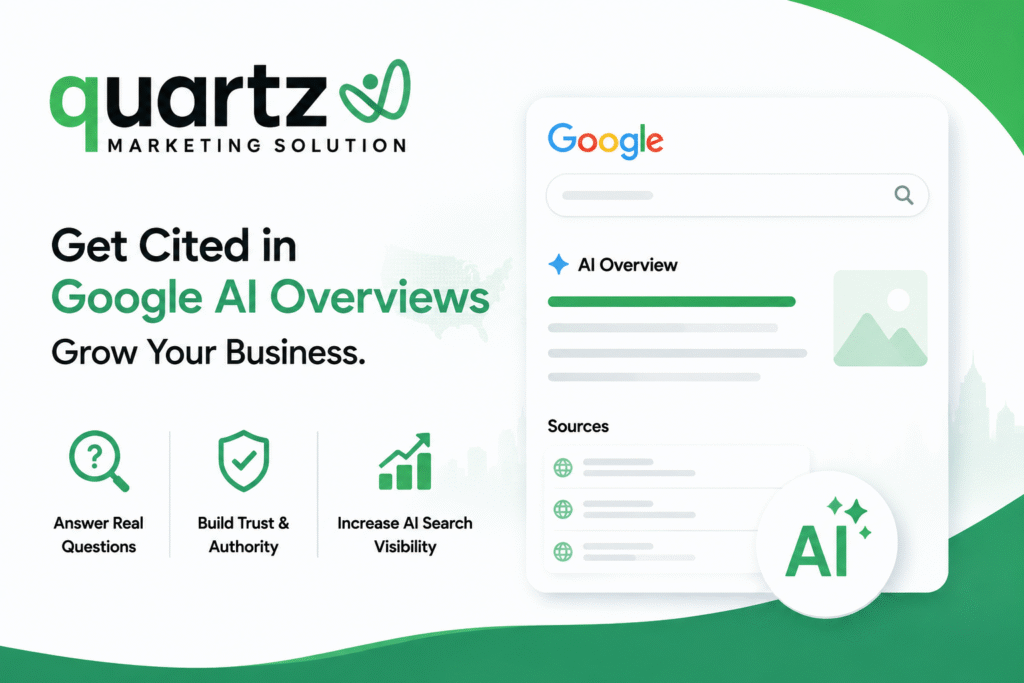
Google search is changing quickly. Instead of showing only the familiar list of blue links, Google now often places an AI Overview at the top of the results, giving users a quick summary with links to relevant websites. For U.S. businesses, this creates a new opportunity to reach potential customers, but also raises an important question: how can your website get cited in these AI-generated answers? There is no secret formula or guaranteed shortcut. However, businesses can improve their chances by publishing useful, trustworthy, well-structured content, answering real customer questions, strengthening their SEO, and making their website easy for Google to understand. The goal is not to chase an AI ranking trick, but to build a website that provides information Google can confidently use and recommend.
What Are Google AI Overviews?
An AI Overview is a short, AI-generated summary that appears at the top of some Google searches. It combines information from multiple relevant web pages and provides links to its sources. Unlike traditional search results, which mainly show ranked links, AI Overviews give users a direct answer. Importantly, Google’s AI features still rely on its existing Search index, so strong SEO, indexing, relevance, and helpful content remain important.
Why AI Search Matters for U.S. Businesses
Search behavior is changing across industries. Informational searches may generate fewer website clicks as AI Overviews provide direct answers, while high-intent searches still offer strong opportunities. Local businesses, e-commerce brands, SaaS companies, and professional services can benefit by creating useful, specific content that Google may cite. Organic search isn’t disappearing; it’s evolving, so businesses need to focus on both rankings and AI visibility.
Can SEO Help Your Business Appear in Google AI Overviews?
Yes, but AI Overview SEO isn’t a completely separate discipline from traditional SEO. Google’s AI features rely on pages that are already crawled, indexed, relevant, and eligible to appear in Search. Simply optimizing for AI won’t help if your website has weak technical SEO or low-quality content.
The practical approach is to strengthen the fundamentals: create helpful content, answer specific questions clearly, build topical authority, improve site structure, and establish trust. These factors can support visibility in both traditional search results and AI-generated answers. However, there is no guaranteed method to make Google cite a particular page in an AI Overview.
7 Ways to Improve Your Chances of Being Cited in AI Search
1. Answer Real Customer Questions
Create content that answers specific questions clearly and early, using the natural language your customers actually search.
2. Build Topic Depth
Create connected content around your main topics, covering FAQs, comparisons, pricing, processes, and common problems with strong internal linking.
3. Add Original Insights
Use real examples, case studies, original data, expert opinions, and first-hand experience instead of rewriting what competitors already say.
4. Improve Website Structure
Use clear headings, descriptive URLs, logical navigation, internal links, mobile-friendly design, and an easily crawlable site structure.
5. Build Trust and Authority
Show clear business information, author details, experience, contact information, and genuine customer reviews where appropriate.
6. Use Relevant Schema Markup
Add structured data that accurately describes your content. Schema can help search engines understand your pages but does not guarantee AI Overview citations.
7. Update Content Using Real Data
Use Google Search Console, analytics, and customer questions to identify content gaps and regularly improve pages based on actual search performance.
Google AI Overviews SEO vs. Traditional SEO
| Traditional SEO | AI Search / AI Overview Visibility |
| Targets specific keywords and ranking positions | Relies on content already ranking well for related terms |
| Focuses on matching search intent through page targeting | Focuses on directly and clearly answering the underlying question |
| Content can be long-form or list-based | Content that leads with a clear, extractable answer tends to perform better |
| Authority built through backlinks, reputation, and consistency | Same authority signals apply, plus original insight and topical depth |
| Technical SEO (crawlability, indexing, site speed) required | Same technical requirements — a page must be indexable to be eligible |
| User experience affects rankings and engagement | Same UX principles apply; unclear content is harder to summarize accurately |
| Citations shown as ranked links | Citations shown as inline source links within an AI-generated summary |
| Measured through rankings, clicks, and organic traffic | Measured through visibility in AI features plus traditional metrics, since standardized AI-citation tracking is still developing |
What U.S. Businesses Should Avoid
- Keyword stuffing content in an attempt to force relevance
- Mass-producing generic, AI-written articles with no original value
- Copying or closely paraphrasing competitor content
- Using fabricated statistics or unverifiable claims
- Publishing thin, near-duplicate location pages just to target more cities
- Chasing “AI ranking hacks” promoted without evidence
- Ignoring basic technical SEO while focusing entirely on AI search trends
- Assuming any single tactic schema, an llms.txt file, a specific content format — guarantees an AI citation
How Quartz Marketing Solution Can Help
Adapting to AI-driven search isn’t really about learning a new discipline; it’s about doing SEO fundamentals well and layering in the kind of original, well-structured content that both readers and AI systems find genuinely useful. That takes time, consistent execution, and a strategy that connects content, technical SEO, and local search rather than treating them as separate projects. Businesses that want help building that kind of foundation can look into digital marketing services that combine SEO, content strategy, and technical optimization into one coordinated approach rather than tackling AI search visibility as an isolated, one-off effort.
FAQs
What is Google AI Overview SEO?
It means optimizing your website so it has a better chance of being cited in Google’s AI-generated answers. It builds on traditional SEO, including relevance, content quality, and technical accessibility.
How can my business appear in Google AI Overviews?
Create helpful, well-structured, trustworthy content that directly answers customer questions. There is no guaranteed way to secure a citation.
Does traditional SEO still matter?
Yes. Strong technical SEO, relevant content, indexing, and authority remain important for AI search visibility.
Can AI-generated content appear in AI Overviews?
Yes, but quality matters. AI-assisted content should provide genuine value, accuracy, and original insights rather than being mass-produced or generic.
How long does AI search visibility take?
Results vary by competition, industry, and website health. Consistent SEO improvements generally take months, not days.
Can a digital marketing agency help?
Yes. An experienced agency can improve technical SEO, content strategy, topical authority, and overall search visibility without promising guaranteed AI citations.