An HVAC company gets steady referrals and the occasional call from Google. June is busy. February is quiet, and the owner can’t say why. A roofing contractor spends money on ads every month but can’t tell whether those ads produced a single profitable job.
Both problems have the same root. Home services marketing is more than ads and social posts. It means helping the right homeowners find your business, trust it, and take the next step, whether that’s a phone call, a quote request, or a booked estimate.
This guide covers what home services marketing is, which strategies matter most, how to build a plan, and how to measure whether it’s working.
What Is Home Services Marketing?
Home services marketing is how local service businesses attract customers, build credibility, and turn inquiries into booked jobs. It combines online and offline tactics. HVAC, plumbing, roofing, electrical, landscaping, cleaning, pest control, remodeling, and general contracting companies all use it.
It works differently from marketing an online store or a national brand. A homeowner with a burst pipe isn’t browsing. They want someone nearby, available today, and trustworthy enough to let inside the house. Location, urgency, reviews, availability, and response time often decide the job before price comes up.
Why Is Marketing Important for Home Service Businesses?
Referrals are valuable, but they’re hard to schedule. Most contractors run into the same problems:
- Too much reliance on word of mouth
- Inconsistent inquiries and seasonal swings
- Strong local competition
- Weak visibility in Google search
- Expensive or low-quality leads
- Website visitors who never call
- Missed calls and slow follow-up
- No clear way to measure ad results
The Most Effective Home Services Marketing Strategies
1. Local SEO
Local SEO helps your business show up when homeowners search for a service in your area. It rests on clear service pages, accurate business details, helpful content, and sensible internal linking.
Target the service-and-city searches you actually serve. Skip the trap of publishing dozens of near-identical city pages with only the town name swapped. Each location page should say something real about the area, the jobs you’ve done there, or the problems homeowners there face. Quartz’s SEO services page shows how search work is typically structured.
2. Google Business Profile optimization
Your profile is often the first thing a customer sees. Keep your name, phone number, hours, and service areas accurate. Choose relevant categories, list your services, and upload real photos of your crew and finished work. Respond to reviews and update the profile when anything changes.
A well-kept profile helps customers judge whether you’re a good fit. It doesn’t guarantee a Maps ranking, and no one can honestly promise one.
3. Google Ads and Local Services Ads
Paid search reaches homeowners who are looking right now. Results depend on targeting, budget, call tracking, landing page quality, and lead quality.
Local Services Ads are only available in eligible categories and locations, and they typically involve verification such as licensing, insurance, or background checks. Check Google’s current eligibility flow before planning around them. Paid ads also aren’t automatically the cheapest source of leads, and the right campaign type varies by business.
4. Website and landing page optimization
Picture a homeowner with a leaking pipe, on their phone, standing in a wet kitchen. If your site loads slowly, buries the phone number, or demands a long form, they’ll tap the next result.
Strong service pages state what you do, where you work, and how to reach you. They include a click-to-call button, trust signals like licensing and real photos, and a short quote form that works on a small screen.
5. Reviews and reputation management
Reviews help prospects judge reliability before they ever talk to you. Ask every customer, not just the happy ones, and make the request easy. Reply to feedback professionally, including the critical kind.
Never buy reviews, write fake ones, offer incentives that break platform rules, or screen customers before asking.
6. Content marketing
Useful content answers the questions customers already have: how to prepare an HVAC system for winter, warning signs of roof damage, what causes recurring drain clogs, or how to get a property ready for a renovation.
Quality beats volume. A few genuinely helpful pages do more than many repetitive keyword pages.
7. Lead follow-up and automation
A quote request that sits for hours often goes to the competitor who answered first. Missed-call text-backs, CRM tracking, appointment reminders, and notifications can keep leads from slipping away.
Automation should support your team, not replace it. Complicated jobs and upset customers still need a real person. If you’re exploring workflow automation, AI automation services can help identify which steps are worth automating.
How to Build a Home Services Marketing Strategy
- Identify the jobs you want. Higher-margin installs, recurring contracts, and emergency calls each need different marketing.
- Define your service area. Be specific about the cities and neighborhoods you can serve profitably.
- Review competitors and local visibility. Search your own services the way a customer would.
- Fix your website and Google Business Profile. Weak basics waste every dollar spent after them.
- Choose channels that fit. Match organic and paid options to your trade, market, and budget.
- Build service pages and helpful content. Cover your core services first.
- Set up a reliable lead-response process. Decide who answers, how fast, and what happens after hours.
- Track what matters. Record calls, forms, qualified inquiries, estimates, and booked jobs.
- Review and adjust. Check results regularly and shift effort toward what works.
Home Services Marketing Trends to Understand in 2026
AI-assisted search. Homeowners increasingly see AI-generated summaries alongside traditional results. Clear, accurate, well-structured pages and consistent business information help, though nothing guarantees visibility.
Helpful content that shows real expertise. Photos from real jobs, plain explanations, and accurate details are more convincing than generic copy.
Better call and form tracking. Knowing which source produced which call has become standard practice.
Mobile-first experiences. Most urgent searches happen on phones, so speed and tap-to-call matter.
Seasonal and location-specific campaigns. Furnace tune-ups, storm repairs, and spring landscaping all have their own timing.
CRM and follow-up automation. Useful for many teams, though small businesses don’t need expensive systems to start.
Coordinated organic and paid search. Ads can fill the pipeline while SEO builds over time. Broader digital marketing services can tie both under one plan.
Lead quality and booked-job reporting. The question is shifting from “how many leads?” to “how many good jobs?”
How to Measure Home Services Marketing Results
Traffic and impressions are easy to track and easy to misread. What matters is what turns into work. Useful measures include:
- Phone calls and form submissions
- Qualified leads
- Cost per lead
- Estimates booked
- Estimate-to-job conversion rate
- Cost per acquired customer
- Revenue from tracked campaigns
- Marketing return on investment, where your data is reliable
- Missed calls and response times
Not every inquiry becomes a profitable job. One channel may bring many small repairs while another brings fewer, larger projects. Track which sources send the customers and work you actually want. If your main gap is lead volume or quality, a dedicated lead generation approach can help you compare sources.
Why Consider Quartz Marketing Solution for Home Services Marketing?
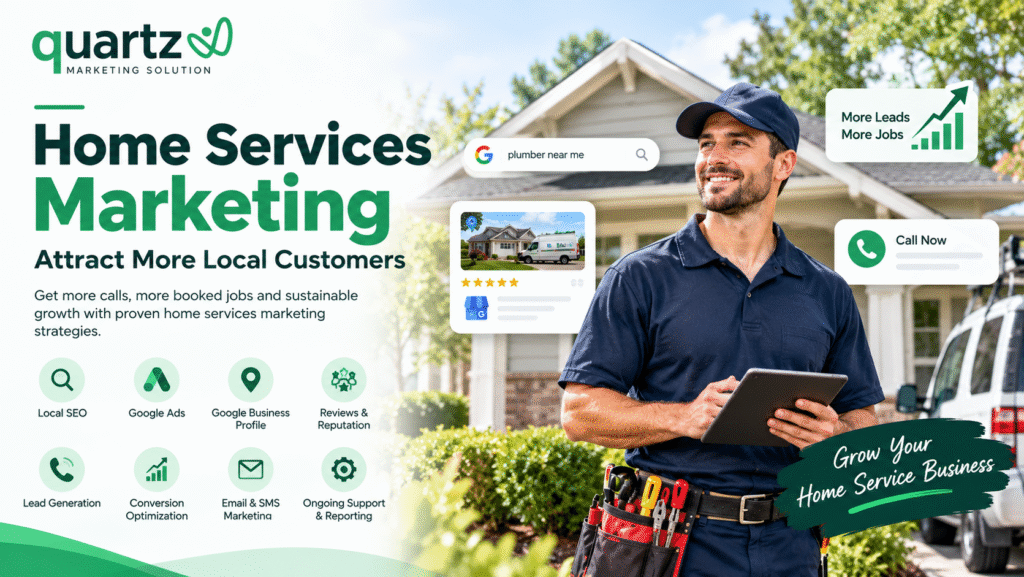
Quartz Marketing Solution offers home services marketing for HVAC, plumbing, roofing, electrical, landscaping, cleaning, remodeling, and other trades. Its approach connects SEO, local search, paid ads, website conversion, content, and reputation management to calls, quote requests, and booked jobs.
The services page also lists call tracking and analytics, retargeting, and automated follow-up for missed calls. It describes a five-step process of audit, strategy, build, launch and optimize, and reporting, with reporting focused on calls, leads, and bookings rather than traffic alone. It also states plainly that no rankings or lead counts are guaranteed, which is the right expectation for any agency to set.
Conclusion
Effective home services marketing combines local visibility, a trustworthy online presence, appropriate advertising, fast follow-up, and clear measurement. None of it works well alone. Strong reviews don’t help if calls go unanswered, and good ads waste money on a weak landing page.
Fix the biggest gap first, track real outcomes, and adjust. If you’d like to see how Quartz Marketing Solution approaches this, you can explore its home services marketing page or contact the team to talk through your situation.
FAQs
What is home services marketing?
It’s the set of online and offline activities local service businesses use to attract homeowners, build trust, and win jobs. It typically includes local SEO, Google Business Profile management, advertising, website conversion, reviews, and follow-up.
How do home service businesses get more leads?
Most combine visibility with fast response. That means accurate Google listings, helpful service pages, a steady flow of genuine reviews, a mobile-friendly site, and prompt follow-up. Some also add paid search where it fits their budget and market.
What is the best marketing strategy for contractors?
There isn’t one that fits every trade. Emergency trades often lean on paid search and local listings. Remodelers may benefit more from portfolios, reviews, and content. Start with your current bottleneck, then add channels once the basics work.
How does local SEO help home service businesses?
It helps your business appear when nearby homeowners search for your services. Accurate listings, clear service pages, reviews, and location relevance all contribute. It builds gradually, and results depend on your market and competition.
Are Google Ads worth it for home service companies?
Often, when tracking is in place. Ads reach people actively searching, but costs and lead quality vary by trade and area. Measure booked jobs, not just clicks. Local Services Ads are limited to eligible categories and locations.
How much does home services marketing cost?
It varies by market, trade, competition, scope, website condition, and budget, so no standard price applies. Ask any provider what’s included, how results are reported, and how ad spend is handled.
How can a contractor improve Google Business Profile visibility?
Keep details accurate, choose relevant categories, list services, add real photos, and respond to reviews. Make sure your name, address, and phone number match your website. Rankings can’t be guaranteed.
How long does home services SEO take to show results?
It depends on competition, website condition, and the work involved. SEO usually takes months rather than days, which is why some businesses run ads alongside it. Be wary of anyone promising a fixed timeline.