Picture a Shopify store with steady traffic and active ad campaigns. Sales are still uneven. Ad costs keep climbing, most visitors leave without buying, and few customers come back for a second order. The natural reaction is to spend more on ads. Often, that makes the problem more expensive instead of solving it.
Growth usually depends on several things working together: the quality of your traffic, your website experience, your product margins, your retention efforts, and how accurately you measure results. This is where an ecommerce growth agency comes in. It helps you find the real bottleneck and fix it in a sensible order.
This guide explains what these agencies do, how to evaluate one, and which metrics show whether the work is paying off.
What Is an Ecommerce Growth Agency?
An ecommerce growth agency is a marketing partner that helps online stores increase sales by improving customer acquisition, website conversions, order value, and repeat purchases. It does this through coordinated strategy rather than isolated tactics.
The difference from a single-channel vendor matters. A channel specialist might run your Google Ads and report on clicks. A growth partner looks at the whole customer journey: where shoppers come from, what happens on the product page, whether checkout loses buyers, and whether customers return after the first order. That is a narrower, more store-specific job than general digital marketing, which covers many business types.
What you actually need depends on your store’s size, goals, products, budget, and existing setup. A new store may need better product pages before it needs more traffic. An established brand may already convert well but depend too heavily on one ad platform.
What Does an Ecommerce Growth Agency Do?
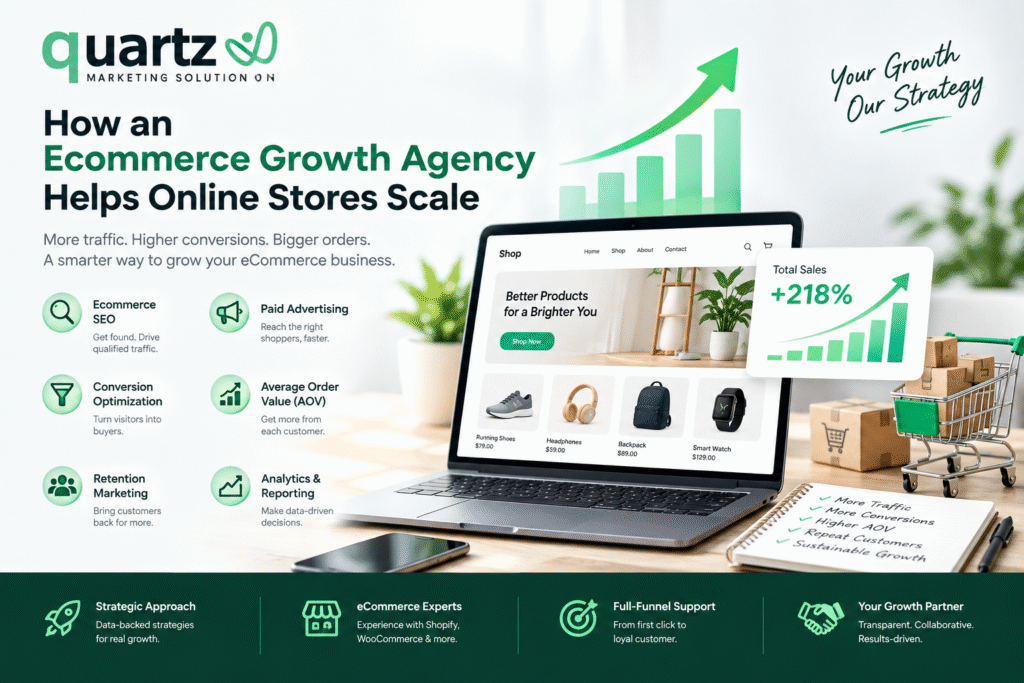
- Customer acquisition: Reaching relevant shoppers through the channels that fit your product and margins.
- Ecommerce SEO: Improving how product, category, and informational pages appear in search. A store selling running gear, for example, might build a buying guide that supports its category pages.
- Paid advertising: Using search, shopping, and social ads to reach people likely to buy.
- Conversion rate optimization: Finding friction in product pages, navigation, mobile layouts, and checkout.
- Average order value improvement: Testing bundles, cross-sells, and other offers.
- Retention marketing: Encouraging repeat purchases through email, SMS, and useful post-purchase messages.
- Analytics and reporting: Tracking traffic, conversions, revenue, acquisition costs, and customer behavior so decisions rest on data.
Why Do Ecommerce Businesses Need a Growth Agency?
- Advertising costs keep rising.
- Visitors browse but don’t buy, and carts get abandoned.
- Organic visibility is weak, and product pages say too little.
- Order values are low, and customers rarely return.
- Attribution is unclear, so it’s hard to tell which campaigns are profitable.
- Too much revenue depends on one channel.
A growth-focused approach starts by asking which of these is the biggest constraint. If your checkout loses a large share of buyers, a bigger ad budget just sends more people into a leaky funnel.
One caution: no agency can guarantee results. Performance depends on demand, competition, pricing, product quality, margins, budget, and execution. Be wary of anyone who promises otherwise.
The Four Main Areas of Ecommerce Growth
A simple framework helps keep priorities straight.
1. Grow Qualified Traffic
SEO, paid search, paid social, and content can all bring shoppers to your store. What matters is intent. Fewer visitors who are ready to buy are worth more than a large volume of casual browsers. Good traffic strategy matches each channel to a real buying need.
2. Improve Conversion Rates
Look at product information, trust signals, mobile usability, page speed, navigation, shipping details, and checkout steps. Surprise shipping costs and forced account creation are common reasons people leave. Improving the experience you already have can be as valuable as attracting new visitors.
3. Increase Average Order Value
Bundles, complementary products, volume offers, and free-shipping thresholds can raise order size where they suit the product. The offer should protect your margin. A discount that lifts order value but erases profit is not growth.
4. Improve Customer Retention
Email, SMS, loyalty programs, replenishment reminders, and helpful post-purchase communication can bring customers back. Tactics should fit the category. A reminder works well for consumables, but it makes little sense for a one-time furniture purchase.
These four areas feed each other. Better conversion makes paid traffic more efficient, and stronger retention improves what you can afford to spend on acquisition. It is a way of thinking, not a guaranteed formula.
How to Choose the Right Ecommerce Growth Agency
- E-commerce experience: Have they worked with stores like yours?
- Platform knowledge: Do they understand Shopify or whatever platform you use?
- Acquisition and conversion skills: Can they work on both traffic and the on-site experience?
- Clear strategy: Can they explain their approach in plain language?
- Financial understanding: Do they grasp product margins and customer acquisition costs?
- Reliable reporting: Will you see revenue-based numbers, not just impressions?
- Clear deliverables and pricing: Do you know what you’re paying for?
- Transparent communication: How often will you hear from them, and who will you talk to?
- Account access: Will you own your advertising and analytics accounts?
- Testing process: How do they decide what to try, and what happens when a test fails?
- Realistic expectations: Do they avoid promising specific outcomes?
Ecommerce Growth Trends to Understand in 2026
- AI-assisted marketing: AI can speed up analysis, reporting, and workflow automation. It doesn’t automatically increase sales, and it still needs human judgment.
- AI-powered search and product discovery: Shoppers increasingly ask AI tools for recommendations. Clear, accurate product content gives your store a better chance of being understood, though no one can promise citations.
- Structured product data: Clean titles, attributes, and schema help search engines and shopping platforms interpret your catalog.
- First-party data: Email lists, purchase history, and on-site behavior are more dependable as tracking rules tighten.
- Mobile experience: If most of your visitors shop on phones, mobile speed and checkout flow deserve early attention.
- Coordinated SEO and paid ads: Keyword and search data from one channel can sharpen the other.
- Lifecycle marketing: Welcome, abandoned cart, post-purchase, and win-back messages are established practices, not new ones.
- Profitability-focused measurement: More brands are looking past revenue to what each customer actually costs and earns.
Why Consider Quartz Marketing Solution as Your Ecommerce Growth Partner?
Quartz Marketing Solution is built around the connected approach described above. Its ecommerce growth services cover ecommerce SEO, paid advertising across Google, Meta, TikTok, and Amazon advertising, conversion rate optimization, Klaviyo and Attentive email and SMS marketing, and creative support. The team works with Shopify, WooCommerce, BigCommerce, and Amazon sellers. For B2B, wholesale, and high-ticket stores, it also offers lead generation for B2B and wholesale stores.
The process starts with a diagnostic review of SEO, paid accounts, email flows, conversion basics, and unit economics. Findings are then prioritized by expected revenue impact against effort, and reporting ties to revenue, CAC, and lifetime value trends. That order is useful: some stores need conversion fixes before more ad spend, and others need technical SEO cleanup first.
Conclusion
Sustainable growth takes more than a bigger ad budget. Stores need to attract relevant shoppers, make buying easy, measure profitability honestly, and give customers reasons to return.
If you’re weighing outside help, start with your biggest bottleneck and ask any agency how it would address it. To see how Quartz Marketing Solution approaches this, explore its ecommerce growth services or get in touch to talk through your store’s situation.
FAQs
What does an ecommerce growth agency do?
It manages and coordinates the work that drives online sales, including acquisition channels, conversion improvements, retention marketing, and reporting. The goal is to find what is holding the store back and fix it in order of impact.
How can an ecommerce growth agency increase online sales?
By bringing in more relevant shoppers, reducing friction that stops them from buying, raising order value, and encouraging repeat purchases. The right mix depends on where your store is losing the most revenue.
What is the difference between an ecommerce marketing agency and an ecommerce growth agency?
The terms overlap. A marketing agency may focus on running channels, while a growth agency is expected to connect those channels to revenue, margin, and retention. Check the actual scope rather than relying on the label.
Is an ecommerce growth agency worth it for a small business?
It can be, if you have a product with demand and need expertise across several areas without building a team. If your budget is very tight, a narrower engagement focused on your biggest bottleneck may be wiser.
How much does an ecommerce growth agency cost?
Costs depend on scope, services, store size, advertising budget, and complexity. Ad spend is usually separate from agency fees. Ask for a clear breakdown of deliverables and what is included.
How long does ecommerce growth take?
It varies by channel, competition, website condition, budget, and execution. Paid campaigns can show signals sooner than SEO, but no one can promise a fixed timeline.
Which metrics should an ecommerce growth agency track?
At minimum: conversion rate, revenue by channel, average order value, CAC, repeat purchase rate, lifetime value, and contribution margin. Reports should connect activity to profit, not only traffic.
Can an ecommerce growth agency help Shopify stores?
Yes, if it has Shopify experience. Look for knowledge of themes, page speed, product data, apps, and analytics setup. Services like Shopify conversion optimization are a good example of platform-specific work to ask about.