
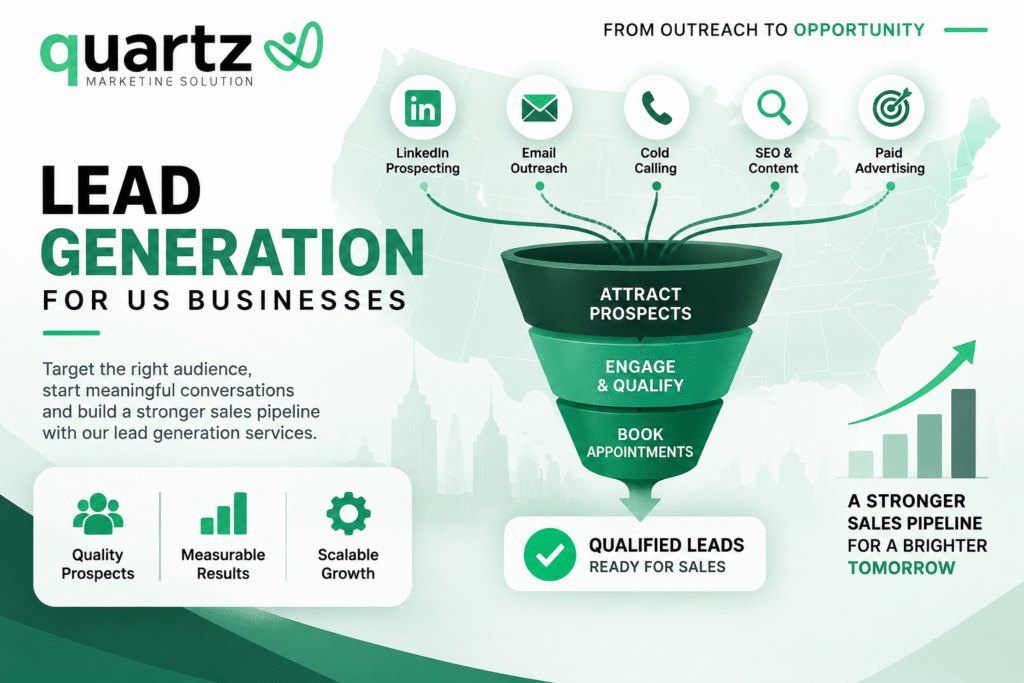
Most companies don’t actually have a traffic problem. Their website gets visitors, their ads get clicks, and their phone rings occasionally. What they have is a qualified-lead problem — plenty of activity, but not enough of it turns into real sales conversations with people who can actually buy.
That’s the gap a lead generation company is built to close. Instead of chasing random inquiries and hoping some of them stick, the goal is a steady, predictable pipeline of prospects who fit the business, have a real need, and are worth a salesperson’s time. This article breaks down what lead generation services actually involve, how the process works in practice, and what to look for if you’re considering hiring a lead generation agency in the US.
What Is a Lead Generation Company?
A lead generation company helps businesses find and connect with potential customers who fit their ideal customer profile. Instead of simply collecting names, the focus is on identifying prospects who are likely to need the product or service and starting relevant conversations.
The process typically begins by defining the ideal customer based on factors such as industry, company size, job role, budget, and business needs. Prospects are then researched, verified, contacted, and qualified before being passed to the sales team.
What Are Lead Generation Services?
Lead generation services cover the specific tactics used to find, contact, and qualify prospects. A good agency doesn’t just run one channel; it combines a few, depending on the industry and sales cycle.
- Lead research and prospect identification: building accurate, verified lists based on the ideal customer profile, not scraped data
- B2B lead generation: targeting decision-makers at companies rather than individual consumers
- LinkedIn prospecting: reaching people where B2B buyers actually spend time researching vendors
- Cold calling: still effective when the list is tight, and the pitch is relevant, not a script read to anyone who picks up
- Email outreach: personalized sequences based on the prospect’s role and pain points, not mass blasts
- Appointment setting: booking qualified calls directly onto a sales team’s calendar
- Paid lead generation: using Google Ads or social advertising to capture demand from people already searching
- Inbound lead generation: content and SEO that attract prospects who find the business on their own
- Lead qualification: screening responses so sales teams only spend time on real opportunities
- Lead nurturing: following up with prospects who aren’t ready yet, so they’re not lost
- CRM and pipeline support: keeping data organized so nothing falls through the cracks
How Lead Generation Services Work
- Define the ideal customer profile: industry, company size, job title, and buying triggers
- Research potential prospects: build a list of companies and people who match
- Build and verify prospect lists: confirm contact details and current roles so outreach doesn’t bounce
- Choose the right outreach channels: LinkedIn, email, phone, or a combination
- Start personalized outreach: messaging built around the prospect’s specific situation
- Qualify responses: separate genuine interest from polite brush-offs
- Book sales appointments: hand off warm, qualified conversations to the sales team
- Track results and improve the campaign: adjust messaging, targeting, or channels based on what’s converting
Why Qualified Leads Matter More Than Lead Volume
It’s tempting to judge a campaign by how many leads show up in a spreadsheet. But 200 unqualified leads that go nowhere cost a sales team more time — and more frustration — than 20 leads that are genuinely ready to talk.
Lead quality comes down to a few things: does the prospect have budget authority, is there an actual need, and is the timing reasonable? A software company selling to enterprise clients doesn’t benefit from a flood of leads from solo founders who can’t afford the product. Those leads look good in a report but drag down conversion rates and waste sales hours that could go toward real opportunities.
Lead Generation Channels That US Businesses Can Use
No single channel works for every business. The right mix depends on the sales cycle, budget, and who the buyer is.
SEO and content bring in people actively searching for a solution, which usually means warmer intent but it takes time to build.
LinkedIn works well for B2B prospecting, especially when the buyer is a specific role like a director or VP who’s active on the platform.
Cold calling still has a place when the prospect list is well-targeted, and the messaging speaks to a real, specific problem rather than a generic pitch.
Email outreach works best as personalized sequences tied to the prospect’s industry and role, not a one-size-fits-all template sent to thousands of addresses.
Paid advertising through Google Ads or social platforms can create faster results, but only pays off with proper targeting and conversion tracking in place.
Referral and partnership channels often produce the highest-intent opportunities of all, since the prospect arrives with built-in trust from whoever referred them.
What Should You Look for in a Lead Generation Company?
- Real understanding of your industry, not a generic playbook
- A clear process for defining your ideal customer profile
- An actual lead qualification step, not just list delivery
- Personalized outreach instead of templated spam
- Multi-channel capability rather than a single tactic
- Transparent reporting you can actually understand
- CRM integration so leads don’t get lost
- Appointment-setting support, not just contact information
- Clear communication and realistic expectations
- Measurable KPIs tied to qualified opportunities, not vanity metrics
Be cautious of any agency promising a fixed number of guaranteed leads without first understanding your business.
How Quartz Marketing Solution Approaches Lead Generation
Quartz Marketing Solution works with businesses that need a more consistent, qualified pipeline rather than a one-time spike in inquiries. The approach typically combines lead research, LinkedIn prospecting, cold calling, email outreach, appointment setting, targeted advertising, and lead qualification, chosen based on the client’s industry, sales cycle, and target buyer.
The focus stays on connecting sales teams with prospects who are actually worth a conversation, rather than inflating lead counts. Businesses exploring this can explore Quartz Marketing Solution’s lead generation services to see how the process is structured for different industries.
How to Measure Lead Generation Success
- Number of qualified leads
- Cost per lead vs. cost per qualified lead
- Appointment rate
- Lead-to-opportunity rate
- Conversion rate
- Sales pipeline value
- Customer acquisition cost
- Revenue generated from the campaign
Tracking leads alone tells you almost nothing. Tracking what happens after the lead — how many turn into real conversations, and how many of those turn into closed deals — is what actually shows whether a lead generation service is working.
Frequently Asked Questions
What does a lead generation company do?
A lead generation company finds potential customers who match a business’s ideal profile, verifies their information, and starts relevant conversations. Qualified prospects are then passed to the sales team.
What’s the difference between lead generation and lead qualification?
Lead generation finds and contacts prospects. Lead qualification determines whether they have the right need, budget, and timing before sales follow up.
Should I hire an agency or build an in-house team?
It depends on your budget, timeline, and resources. Agencies offer proven processes and experience, while in-house teams provide more control.
How much do lead generation services cost?
Costs vary by industry, channels, outreach volume, and service scope. Ask what’s included, such as research, outreach, qualification, and reporting.
How long does lead generation take?
Some channels can generate responses within weeks, while SEO and inbound strategies usually take longer. Results depend on your industry, audience, and strategy.
Can lead generation work for startups and small businesses?
Yes. Smaller businesses often get better results by targeting a specific customer profile and focusing on one or two effective channels.