Many business owners come to us with the same problem: they’re running ads, investing in SEO, and posting on social media, but leads still aren’t coming in consistently.
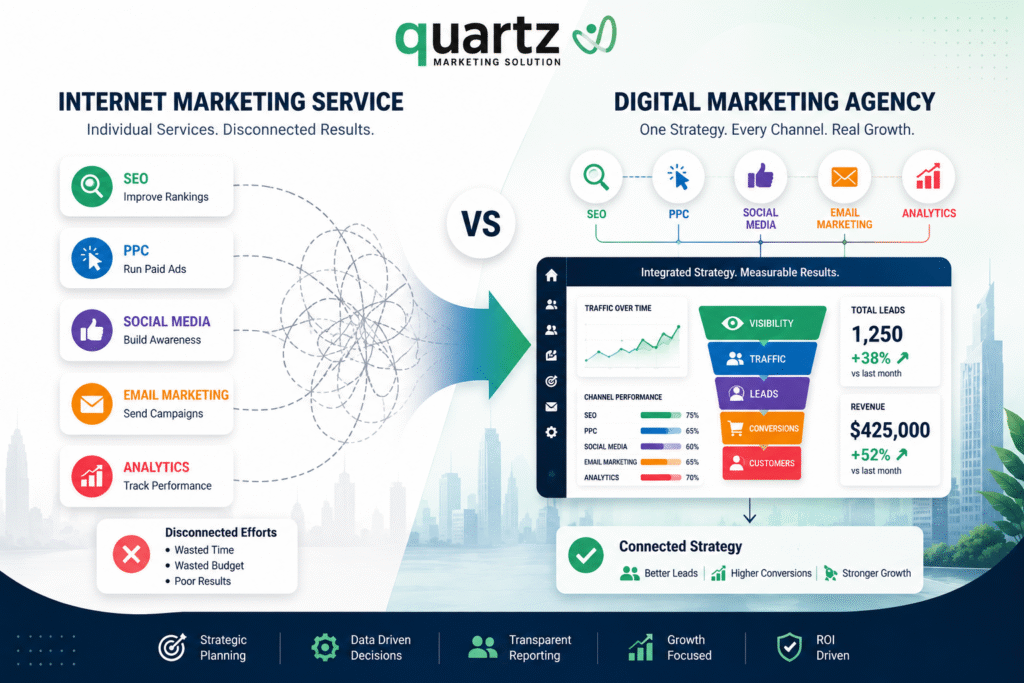
The issue is often not a lack of effort—it’s a lack of strategy. When marketing activities are handled separately, results can suffer. An internet marketing service can help with individual needs, while a digital marketing agency can connect SEO, advertising, content, social media, and lead generation into one focused strategy.
What Is an Internet Marketing Service?
An internet marketing service usually refers to a specific, standalone activity aimed at growing your online presence, things like search engine optimization, pay-per-click advertising, email campaigns, or social media management. You can buy these individually, and plenty of freelancers and small shops specialize in just one.
There’s nothing wrong with this approach if you already know exactly what you need. A local plumber who just wants better Google Maps visibility might only need local SEO. A SaaS company running a single product launch might only need a short-term PPC campaign.
What Does a Digital Marketing Agency Do?
A digital marketing agency typically manages multiple channels under one strategy instead of treating each one as a separate task. Instead of hiring one freelancer for SEO and another for paid ads, an agency coordinates SEO, content, paid media, social, and conversion tracking so they reinforce each other.
Practically, this means your paid ad messaging matches what your landing pages say, your blog content supports the keywords your SEO team is targeting, and your reporting shows how each channel contributes to actual leads or sales, not just clicks.
Internet Marketing Service vs. Digital Marketing Agency
Here’s a simple side-by-side to make the distinction clearer:
| Factor | Internet Marketing Service | Digital Marketing Agency |
| Scope | One channel (e.g., SEO or PPC) | Multiple channels, coordinated |
| Strategy | Task-based | Business-goal based |
| SEO | Often standalone | Integrated with content and paid |
| Paid Advertising | Managed separately | Aligned with organic and messaging |
| Content | May be missing entirely | Built into the strategy |
| Social Media | Sometimes an afterthought | Connected to broader campaigns |
| Lead Generation | Channel-specific | Cross-channel, tracked end-to-end |
| Analytics | Fragmented across tools | Centralized reporting |
| Conversion Optimization | Rarely included | Ongoing part of the process |
| Long-Term Growth | Depends on the vendor | Built into the plan |
Which Internet Marketing Services Does a Business Need?
- SEO: Useful for businesses that want sustainable, non-paid traffic over time. Slower to show results than ads, but it compounds.
- Content marketing: Blog posts, guides, and resource pages that support SEO and build trust with prospects doing research before they buy.
- Local SEO: Essential for service businesses, real estate agents, and healthcare practices that depend on nearby customers finding them on Google Maps and local search.
- Social media marketing: Helpful for brand visibility and community building; more directly tied to sales for e-commerce and consumer brands than for B2B.
- PPC / paid advertising: Best when you need traffic now, are testing a new offer, or want predictable, measurable volume.
- Lead generation: Combines several channels specifically to fill a sales pipeline, often the priority for service businesses and B2B companies.
- Email marketing: Still one of the highest-ROI channels for nurturing leads who aren’t ready to buy yet.
- Conversion optimization: Improving what happens after someone lands on your site or ad, so existing traffic converts at a higher rate instead of just buying more traffic.
- Marketing automation: Useful once lead volume grows enough that manual follow-up isn’t realistic anymore.
- AI-search visibility: A newer consideration: making sure your business shows up accurately when people ask questions through AI Overviews or AI assistants, not just traditional search.
Why SEO and Content Still Matter in 2026
Search behavior has genuinely shifted. Google’s AI Overviews, along with AI assistants people now use for research, mean a chunk of searches never result in a click to any website: a pattern often called zero-click search. That’s a real shift, not a reason to abandon SEO.
Traditional SEO and newer disciplines like answer engine optimization (AEO) and generative engine optimization (GEO) aren’t competing approaches: they overlap heavily. Content that’s well-structured, clearly written, and organized around specific questions tends to perform well both in classic search rankings and as a source AI systems pull from when generating answers. Semantic and entity-focused SEO: making it clear who you are, what you do, and where you operate matters more than ever because AI systems need that clarity to represent your business accurately.
How a Digital Marketing Agency Builds a Complete Growth Strategy
A coordinated strategy generally follows a logical sequence: Visibility → Traffic → Engagement → Leads → Conversion → Retention.
Visibility (SEO, paid ads, social, AI-search presence) brings people to your site. Traffic alone means nothing without engagement content and messaging that keeps people interested. Engagement should lead to leads through forms, calls, or chats. Conversion optimization turns more of those leads into paying customers. And retention: email marketing, remarketing, and ongoing communication keep those customers coming back, which is usually more cost-effective than constantly acquiring new ones.
How to Choose a Digital Marketing Agency in the USA
- Relevant experience in your industry or business model, not just generic marketing claims
- A clear strategy document, not just a list of deliverables
- Transparent reporting you can actually understand, tied to leads and revenue, not vanity metrics
- Real understanding of your business goals, not a templated approach applied to every client
- Responsive communication you shouldn’t have to chase updates
- Technical SEO knowledge, since site structure issues can undermine everything else
- Working conversion tracking from day one, so you know what’s actually generating results
- Adaptability to AI-powered search, since this is actively changing how people find businesses
- Realistic expectations: be cautious of anyone promising guaranteed rankings or overnight results
Why Quartz Marketing Solution
Quartz Marketing Solution works with US businesses that need their marketing channels actually talking to each other instead of running as disconnected experiments. The agency’s approach spans digital marketing, lead generation, AI and automation, branding and creative work, and e-commerce growth built around the idea that visibility only matters if it eventually turns into leads and revenue.
If your business currently has SEO in one place, ads in another, and no one connecting the dots, that’s usually the point where a coordinated strategy starts to matter more than another one-off service.
Frequently Asked Questions
What is an internet marketing service?
It is a specific online marketing activity, such as SEO, PPC, email marketing, or social media marketing.
What does a digital marketing agency do?
A digital marketing agency combines multiple channels into one strategy, helping SEO, advertising, content, and lead generation work together.
What is the difference between internet marketing and digital marketing?
The terms often overlap. Internet marketing mainly focuses on online channels, while digital marketing can cover a broader range of digital platforms.
How much do internet marketing services cost in the USA?
Pricing depends on the services, industry, competition, and business goals. A customized proposal is more useful than a fixed price.
Is SEO part of internet marketing?
Yes. SEO is a major part of internet marketing, along with PPC, content marketing, social media, and email marketing.