
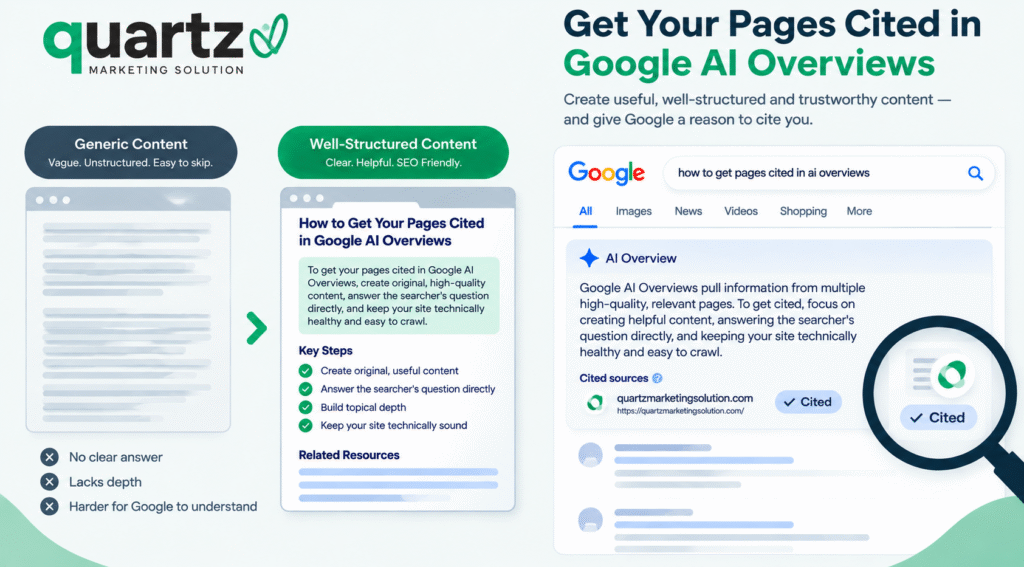
There’s no submit button for this. No form to fill out, no plugin that flips a switch and gets your page pulled into an AI Overview. If someone tells you they can guarantee a citation, that’s a red flag, not a service.
What you can do is make your content the kind of thing Google’s systems would reasonably want to pull from: useful, clearly written, easy to crawl, and trustworthy enough to stand behind a synthesized answer. That’s closer to traditional SEO than most people expect.
This guide walks through what actually influences your odds, based on how Google has publicly described AI Overviews, not guesswork dressed up as certainty. It’s also the same approach Quartz Marketing Solution uses to help U.S. businesses build the content and technical foundation behind strong AI search visibility.
What Are Google AI Overviews?
AI Overviews are the AI-generated summaries that appear above traditional results for certain queries, synthesizing information from multiple pages into one answer with linked sources underneath. Instead of clicking through ten blue links, a searcher gets a direct answer up top, with citations pointing to the pages that informed it.
For website owners, a citation puts your brand in front of someone at the exact moment they’re looking for an answer. It’s a smaller opportunity than a normal ranking spot, though fewer citation slots exist, and Google decides which pages qualify.
Can You Actually Control Which Pages Google Cites?
Not directly. You can’t request a citation or pay for one. What you control is the raw material Google’s systems work with: whether your page is indexed, whether it clearly answers a real question, and whether it’s trustworthy enough to be worth citing.
Google has been consistent on one point in its Search Central guidance: AI Overviews draw from the same web index used for regular results. There’s no separate “AI index” or submission process. In practical terms, a page generally needs to be crawlable, indexable, and competitive in organic search before it has any realistic shot at being cited. Ranking well doesn’t guarantee a citation, but it’s the entry point.
8 Practical Ways to Increase Your Chances of Being Cited
1. Create genuinely useful, original content. A landscaping company writing about patio costs needs to go beyond a single price range; material differences, labor factors, permits, and regional variation all matter.
2. Answer the searcher’s question directly. If someone searches “how long does a roof replacement take,” state the range in the first couple of sentences, then explain the variables.
3. Build topical depth. A dermatology practice with one strong page on eczema, backed by related pages on triggers and treatment options, signals it actually knows the subject.
4. Make information easy for Google to understand. Use descriptive headings that reflect what’s actually in each section; “Starter Plan Pricing” beats a vague “What You’ll Pay.”
5. Strengthen internal linking. Link related pages using descriptive anchor text, not “click here.” It helps Google and human visitors understand how your content connects.
6. Keep technical SEO healthy. A page can be excellent and still get skipped if it’s blocked by robots.txt or buried behind a broken canonical tag. Run a basic crawl audit periodically.
7. Demonstrate first-hand experience and trust. A real estate brokerage discussing local market conditions carries more weight when it reflects actual transactions rather than generic advice.
8. Refresh outdated information. A page about interest rates or software pricing from two years ago is a liability. Review time-sensitive pages on a schedule instead of publishing and forgetting them.
Create Content That Gives Google Something Worth Citing
There’s a real difference between content that exists to rank and content that exists to answer a question well. Generic content restates the obvious; useful content adds something a reader couldn’t already get from the top three results.
That might mean original data from your own business, a home services company sharing job costs it has actually quoted, rather than industry averages pulled from elsewhere. It might mean a comparison a competitor hasn’t bothered to write, or plainly saying “in our experience” and backing it with something concrete.
Imagine a U.S. roofing company publishing a page that simply states what roof replacement costs. A stronger version explains pricing factors, regional differences, material choices, and questions homeowners should ask contractors, giving Google and the reader something worth pointing to.
Make Your Pages Easy to Crawl and Understand
Poor technical health can quietly disqualify a page before content quality is even considered. Indexability comes first; a noindexed or blocked page can’t be cited, full stop. Clear content hierarchy, canonical URLs, and mobile usability round out the basics. These are hygiene factors, not ranking levers on their own.
Does Schema Markup Help With AI Overviews?
Structured data helps search engines understand what a page is about, but it isn’t a shortcut to a citation. Schema like Article or FAQPage markup gives Google machine-readable context; it should accurately describe what’s already on the page, not dress up thin content or claim something the visible text doesn’t say.
What About Backlinks and Authority?
There’s no published “AI Overview backlink score.” What holds up is the broader pattern: sites that credible sources reference tend to be trusted more, and that trust plays into visibility generally. The distinction that matters is between earned references and purchased ones — a plumbing company mentioned by a home improvement publication is a different signal than links bought from a directory network. Google’s spam policies specifically target manipulative link schemes.
How to Optimize an Existing Website for AI Overview Visibility
Start in Google Search Console and find pages already receiving impressions for question-based queries; these are your closest opportunities. Rewrite thin or outdated sections with specific, current information. Strengthen internal links, clean up page structure, and confirm important pages are indexed using the URL Inspection tool. Then track performance over time; visibility shifts don’t happen overnight.
How Quartz Marketing Solution Approaches AI Search Visibility
At Quartz Marketing Solution, we treat AI Overview visibility as an outcome of solid SEO fundamentals, not a separate discipline you can shortcut. We can’t promise a citation nobody honestly can, but we help businesses build the content, structure, and technical foundation that gives them a realistic shot at both organic and AI-driven visibility.
That work usually starts with an audit of what’s already ranking, then moves into SEO services to strengthen topical depth, alongside digital marketing services for businesses needing a broader visibility strategy.
FAQs
How do I get my pages cited in Google AI Overviews?
Focus on original, well-structured content that directly answers a real search query, keep your site technically healthy and indexable, and build genuine topical authority over time. There’s no guaranteed method, but strong fundamentals improve your odds.
Can I submit a page directly to Google AI Overviews?
No. There’s no submission form specifically for AI Overviews. Getting indexed and ranking well in standard search is the closest thing to a starting requirement.
Does ranking on page one guarantee an AI Overview citation?
No. Ranking well is common among cited pages, but plenty of page-one results aren’t cited, and citations can come from pages outside the top positions.
Does schema markup help pages appear in AI Overviews?
It can help Google understand your content more clearly, but it doesn’t force a citation. Schema should accurately reflect what’s visibly on the page.
Do backlinks help with Google AI Overview visibility?
Earned, relevant references can support broader authority and trust signals. There’s no specific “AI Overview” link metric, and low-quality links carry more risk than benefit.
How long does it take to appear in an AI Overview?
There’s no fixed timeline. It depends on how quickly Google recrawls your content, how competitive the topic is, and how established your site already is.