
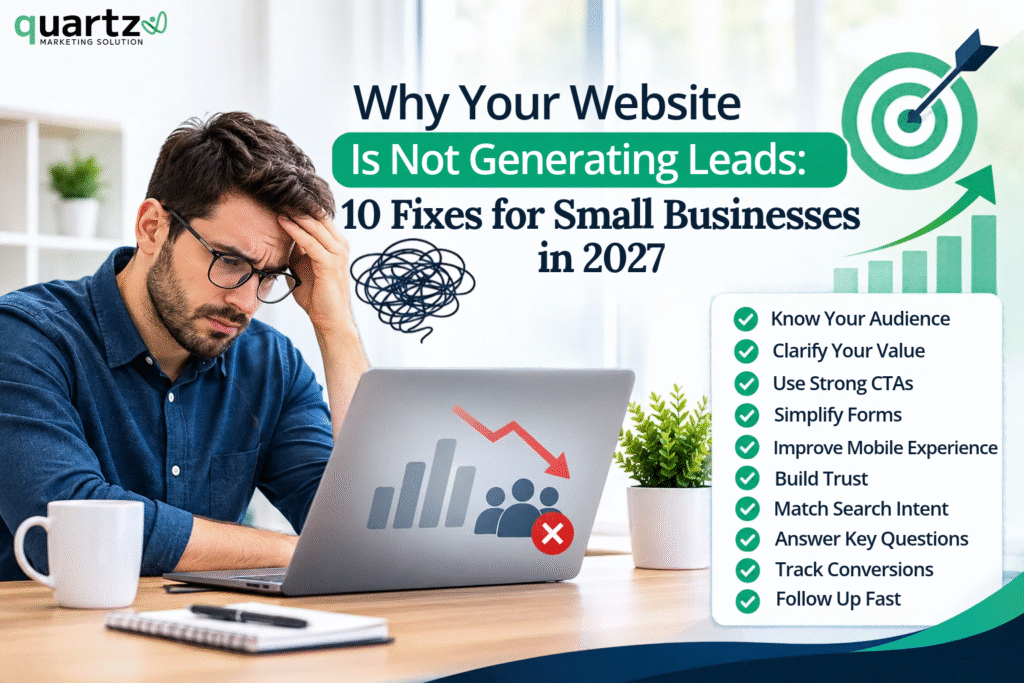
Picture a local contractor with a clean website, a handful of service pages, and steady traffic from Google. The phone rarely rings, and the contact form sits empty.
So why is your website not generating leads? Usually it isn’t a traffic problem alone. Visitors may land on the wrong page, misunderstand your offer, doubt your credibility, hit technical friction, or find no clear next step. Here are 10 practical fixes.
Why Is Your Website Not Generating Leads?
Traffic and leads are different things. For a visitor to become an inquiry, they need to find the right page, understand what you offer, trust you, see a clear next step, and complete it without friction. If any one step fails, visitors leave quietly.
10 Reasons Your Website Is Not Generating Leads (and How to Fix Them)
1. You attract the wrong audience. Traffic only helps if visitors want what you sell and live in your service area. Fix: Review the search terms and traffic sources that bring people in, then compare them to your real customers. Contractors can see how this plays out in home services marketing.
2. Your value proposition is unclear. Visitors should grasp what you do, who you serve, and why you’re worth a call within seconds. Fix: Write a plain headline, a short supporting line, and a visible next step. Skip vague claims like “we deliver excellence.”
3. Your calls to action are weak. “Submit” tells nobody anything. Fix: Use specific wording like “Request a Quote” or “Schedule a Consultation,” place buttons where visitors naturally decide, and confirm they work on mobile. Strong CTAs are the core of any lead generation effort.
4. Your forms ask for too much. Long or confusing forms discourage inquiries. Fix: Ask only what you need to start the conversation, use clear labels and helpful error messages, and show a confirmation. The right length depends on your business. Online stores face the same issue at checkout and signup, which an ecommerce growth partner can review.
5. Your site is slow or awkward on mobile. Many visitors browse on phones. Fix: Test key pages on real devices, compress oversized images, trim unnecessary scripts, and simplify navigation. No single tweak guarantees more leads.
6. Your website doesn’t build trust. People hesitate when they can’t verify you. Fix: Add genuine reviews, accurate contact details, real project examples, and verified credentials near decision points. Never invent testimonials or ratings. Consistent branding and creative also signal a business that’s established and reliable.
7. Your landing pages don’t match search intent. Someone searching for a specific service shouldn’t have to dig through your homepage. Fix: Build focused service pages that answer common questions and include a clear CTA. Avoid dozens of near-identical pages.
8. Your content doesn’t answer customer questions. Missing details about process, timelines, or pricing factors leave visitors uncertain. Fix: Add helpful FAQs, process descriptions, and examples written around real customer concerns. A blog can answer the questions your service pages don’t have room for.
9. You aren’t tracking conversions. Page views don’t show whether the site produces business. Fix: Track form submissions, click-to-call actions, and booked appointments, then test that each one records correctly. Follow applicable privacy and consent requirements.
10. You don’t follow up fast enough. An inquiry loses value if nobody responds. Fix: Assign ownership, send confirmations, and follow up promptly. A CRM or AI and automation tools can help, but they shouldn’t replace personal attention when it’s needed.
How to Find Your Biggest Lead Generation Problem
Work through this checklist:
- Which pages get the most relevant traffic?
- Which pages generate inquiries?
- Where do visitors leave?
- Do forms and call buttons work?
- Do mobile visitors hit problems?
- Which channels bring qualified leads?
- Does tracking match actual inquiries?
Set a baseline, fix the biggest barrier, and measure the result before changing anything else. Conversion rates vary widely by business, so compare yourself to your own history rather than a universal benchmark.
How SEO and Conversion Optimization Work Together
SEO helps the right people find relevant pages. Conversion optimization helps them understand your offer and act. Both rely on search intent, helpful service pages, relevant internal links, clear headings, mobile usability, trust signals, useful CTAs, and reliable tracking. If your site already struggles to convert qualified visitors, more traffic rarely solves it. Pairing SEO with analytics and content is what digital marketing services are built around.
How Quartz Marketing Solution Can Help
If you’d rather not diagnose all this alone, Quartz Marketing Solution offers digital marketing, lead generation, and AI automation support covering SEO, paid ads, content, analytics, and automated follow-up. That range can help you investigate both visibility and conversion problems. If you’d like an outside view of your digital marketing needs, you can contact the team to start a conversation.
Conclusion: Turn Your Website Into a Better Lead Generation Tool
A website needs more than traffic. It needs relevant visitors, clear messaging, a smooth experience, credible information, effective CTAs, reliable tracking, and consistent follow-up. Review your site systematically and fix the biggest barrier first. If you want support, Quartz Marketing Solution is available to help you evaluate where to start.
FAQs
1. Why is my website not generating leads?
Usually one or more steps in the visitor journey is failing: the wrong audience, an unclear offer, weak trust, poor CTAs, technical friction, or missing follow-up.
2. Why does my website get traffic but no inquiries?
Traffic may not match your services, or visitors may not see a clear next step. Check search intent, page content, and whether forms and call buttons work.
3. How can I generate more leads from my website?
Match pages to search intent, clarify your offer, add specific CTAs, simplify forms, build trust, and respond to every inquiry quickly.
4. How do I improve my website conversion rate?
Establish a baseline, identify the biggest barrier, make one focused change, and measure the result before testing the next.
5. Can SEO help a website generate more leads?
Yes, by bringing relevant visitors to helpful pages. It works best alongside clear messaging, strong CTAs, and tracking.