
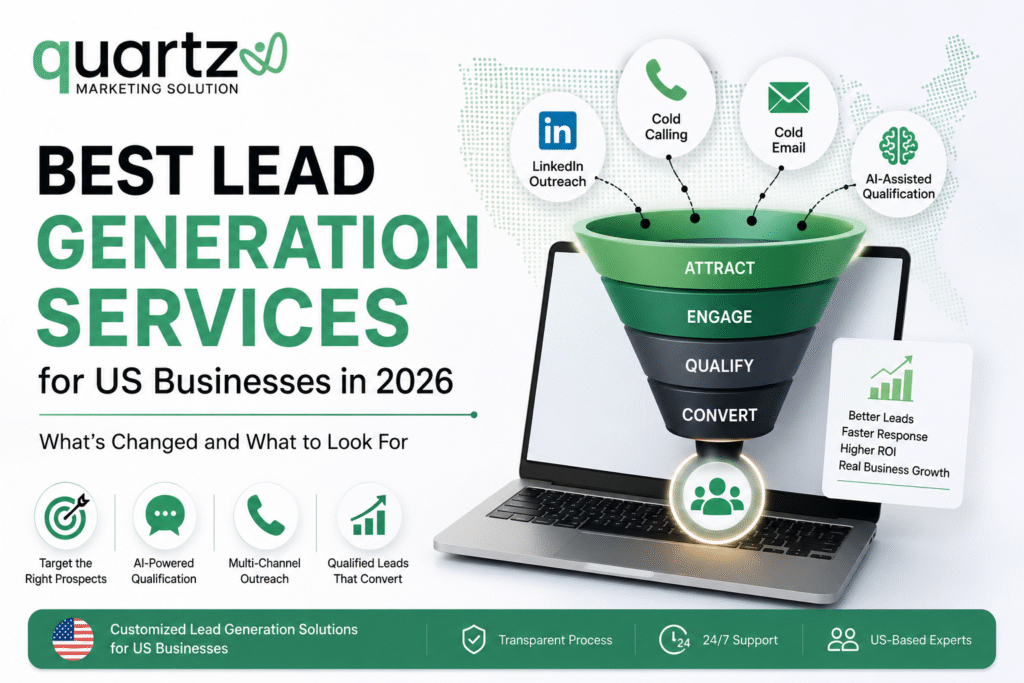
Choosing a lead generation partner used to be a fairly simple decision: find someone who could deliver a steady stream of contacts, agree on a price per lead, and see how it went. That approach doesn’t hold up as well in 2026. Buyers research more before ever talking to a rep, AI has changed how qualification happens, and the businesses getting real value from lead generation services are the ones evaluating providers differently than they did even two years ago.
If you’re a US business weighing whether to bring in outside help or wondering whether your current provider is keeping up, here’s what’s actually changed, and what to look for now.
What “Lead Generation Services” Actually Means Right Now
Lead generation services cover the process of identifying, attracting, and qualifying prospects on a business’s behalf, then handing off sales-ready opportunities to an internal team. What’s shifted is the middle part of that process. A few years ago, “qualifying” often meant confirming basic contact details and maybe a budget range. Now it increasingly involves layering behavioral data: has this prospect visited a pricing page multiple times, engaged with specific content, shown signals of active research on top of traditional fit criteria like industry and company size.
How Providers Are Using AI Differently in 2026
Most established lead generation services now use AI somewhere in their workflow, but where it shows up varies a lot. The more useful applications tend to be:
- Lead scoring: ranking incoming prospects by likelihood to convert, based on behavior and fit
- Routing: getting a qualified lead to the right rep faster, especially outside business hours
- Research and enrichment: pulling relevant company or contact data before outreach begins
- Initial chat qualification: handling basic screening questions before a human takes over
Where it gets less useful is when a provider leans on AI to handle nuanced qualification or personalized outreach entirely. Prospects can generally tell the difference between a message that references something specific about their business and one that’s been generated at scale with a name swapped in. The stronger services use AI to speed up the process, but keep a person involved in anything that requires judgment.
What to Look for in a Lead Generation Company in 2026
Beyond the basics of industry experience and references, a few things matter more now than they used to:
- Does their qualification process account for buyer intent, or just static fit criteria?
- How do they use AI, and where do they keep a human involved?
- What’s their actual speed-to-lead process, from signal to sales conversation?
- Do they work across multiple channels, or is their entire strategy dependent on one?
- How do they define a “qualified lead,” and does that definition match what your sales team actually needs?
- Is their reporting tied to pipeline and revenue contribution, or just activity metrics like emails sent?
- Is pricing transparent, with a clear explanation of what’s included at each tier?
A provider that can’t clearly answer the intent and AI-usage questions is likely still operating on an older model, even if their pitch deck says otherwise.
How Quartz Marketing Solution Approaches Lead Generation Services
Quartz Marketing Solution works with US businesses to build lead generation programs across multiple channels LinkedIn outreach, cold calling, cold email, and AI-assisted qualification rather than relying on a single tactic. The qualification process is built to account for both traditional fit criteria and behavioral signals, so sales teams spend their time on prospects who are actually ready for a conversation rather than names on a list.
The goal is to function as an ongoing growth partner rather than a one-time list provider. Businesses can review the full approach on the lead generation services page.
Common Mistakes When Choosing or Managing a Lead Generation Service
- Judging providers by cost per lead alone, without looking at cost per qualified opportunity
- Assuming all AI-assisted qualification is equivalent across providers
- Not asking about speed to lead until after signing a contract
- Relying on a single-channel provider in a market where channel diversification reduces risk
- Skipping alignment on what “qualified” means before the engagement starts, leading to disagreements later
- Expecting immediate results from SEO-driven lead generation, which builds over months rather than weeks
- Not reviewing reporting regularly enough to catch underperforming channels early
How to Measure Whether a Lead Generation Service Is Working
- Cost per qualified lead, not just cost per lead
- Lead-to-opportunity conversion rate
- Speed to first contact after a lead comes in
- Sales-qualified leads (SQLs) as a share of total leads delivered
- Pipeline value generated, not just lead count
- Revenue directly attributable to the engagement over time
Raw lead volume and open rates are useful diagnostic signals, but they don’t answer the question that actually matters: is this contributing to closed revenue?
Conclusion
The lead generation services worth paying for in 2026 look different from the ones that worked well a few years ago. Buyer intent, faster response times, and AI-assisted (not AI-replaced) qualification are now part of what separates a strong provider from one still running an outdated playbook. Businesses evaluating their options can look at how Quartz Marketing Solution’s lead generation services are built around these shifts to see whether the approach fits their goals.
FAQs
What are lead generation services?
Lead generation services identify, attract, and qualify potential customers on a business’s behalf, delivering sales-ready opportunities so an internal team can focus on closing rather than prospecting.
How much do lead generation services cost in 2026?
Pricing depends on industry, channel mix, target audience, and whether the service includes appointment setting. There’s no single standard rate; a transparent provider should be able to explain their pricing structure clearly, tailored to your specific goals.
How has AI changed lead generation services?
AI is now commonly used for lead scoring, routing, research, and initial qualification, which speeds up the process. The strongest providers still keep a human involved in outreach personalization and final qualification decisions.
Are lead generation services worth it for small businesses?
They can be, particularly for businesses without an internal team capable of running consistent outbound campaigns. The right scope should match the business’s size, budget, and sales capacity.
What’s the difference between a lead generation service and a lead list provider?
A lead generation service actively identifies, qualifies, and often nurtures prospects toward a sales conversation. A lead list provider simply supplies contact data without qualification or follow-up.