Most companies don’t have a traffic problem. They have a conversation problem. The website gets visits, the inbox gets a few inquiries, and the sales team still spends half its week hunting for someone to talk to.
That gap is where lead generation services come in. This guide explains what they include, how to judge lead quality, and how to pick a partner without wasting budget on contact lists that go nowhere.
What Are Lead Generation Services?
Lead generation services are outsourced prospecting, outreach, follow-up, and qualification. Instead of building an in-house sales development team, you work with a provider that already has the process and tools.
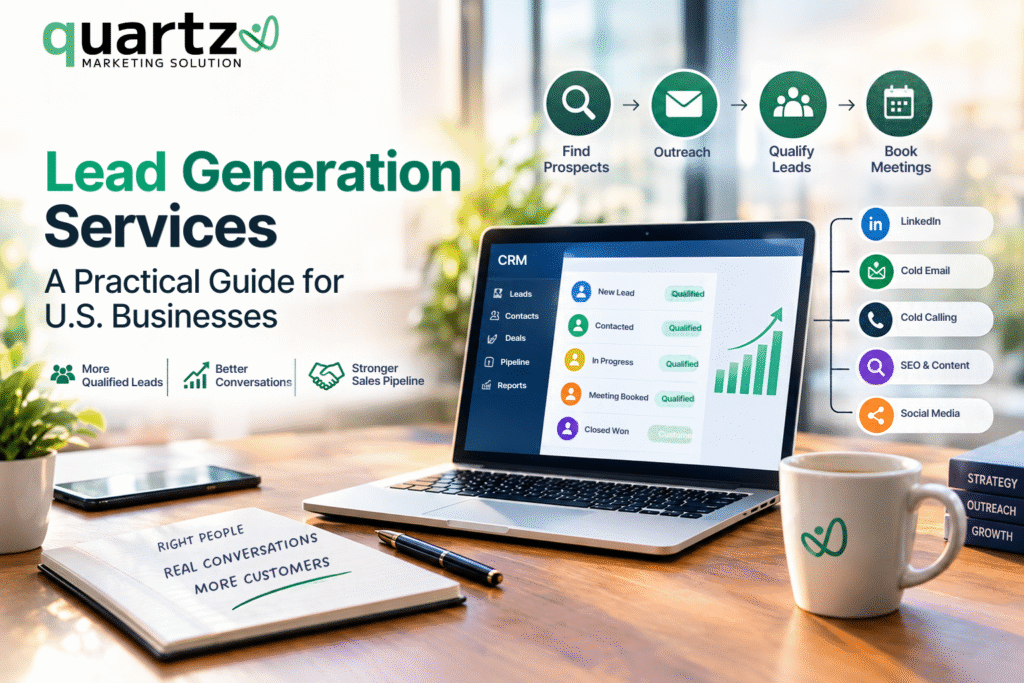
A good provider doesn’t just hand over names. They find people who fit your ideal customer profile (ICP), verify their contact details, reach out through the right channels, and confirm real interest. Then they book the conversation and log everything in your CRM.
The terms get mixed up, so here’s the simple version:
- Lead generation finds and engages potential buyers.
- Lead qualification decides which of them are worth a sales conversation.
- Sales turns those conversations into customers.
Why Lead Generation Matters for U.S. Businesses
Plenty of businesses run on referrals and a bit of inbound. It works until it doesn’t. A slow quarter hits, a key referrer goes quiet, and suddenly there’s no pipeline.
The usual culprits are familiar: stale contact lists, generic outreach, slow follow-up, and a CRM nobody keeps clean. Meanwhile, sales reps burn hours prospecting when they should be selling.
More leads isn’t automatically the answer. A steady stream of relevant prospects is.
What Do Lead Generation Services Include?
The exact scope varies, but most programs cover these pieces:
- ICP research: defining industry, company size, job titles, and buying triggers.
- Prospect identification: building target lists from tools like LinkedIn Sales Navigator and Apollo.io.
- Data verification: checking emails, titles, and company details before outreach starts.
- LinkedIn lead generation: personalized connection and follow-up messages to decision-makers.
- Cold email: sequenced outreach with proper sender setup and deliverability practices.
- Cold calling: researched call lists, not random dials.
- Lead qualification: separating real interest from polite brush-offs.
- Appointment setting: scheduling the meeting with context for your sales team.
- Follow-up campaigns: staying in touch with prospects who aren’t ready yet.
- CRM tracking: logging every touchpoint so nothing slips.
Inbound vs. Outbound Lead Generation
Inbound brings buyers to you through SEO and content marketing, landing pages, paid search, and organic social. It builds momentum over time, but it depends on people already searching for what you sell.
Outbound goes to them through cold email, LinkedIn outreach, cold calling, and account-based prospecting. It makes sense when your market is niche, your deal sizes are large, or you need conversations sooner than SEO can deliver.
Most companies end up using both. Inbound builds credibility and outbound fills gaps, and a prospect who gets a cold email will often Google you before replying.
How AI Is Changing Lead Generation in 2026
AI is genuinely useful in a few places: researching prospects, organizing data, scoring leads, drafting personalized messages, spotting buying signals, and flagging leads that have gone cold. Many of these workflows connect to your CRM through AI and automation services, so follow-ups trigger on time.
But it supports the process; it doesn’t replace judgment. Someone still has to decide whether a prospect fits, whether a message sounds human, and whether a reply signals interest or just politeness. Automated outreach with nobody watching tends to damage deliverability and brand reputation. Any provider claiming AI guarantees results is selling hype.
Why Lead Quality Matters More Than Lead Volume
- Raw contact: a name and email.
- Lead: someone who has engaged in some way.
- Qualified lead: someone who fits your criteria and shows genuine interest.
- Sales opportunity: a real conversation about a real need.
- Customer.
Say a provider sends your team 300 contacts. If most are the wrong job title, the wrong company size, or have no active need, your reps lose days chasing them. Fifteen well-qualified prospects are worth more.
Qualification criteria should cover ICP fit, role, industry, location, business need, timing, and buying intent. Many teams use the classic BANT checklist (budget, authority, need, timeline). What matters is that you and your provider agree in writing on what “qualified” means.
How to Choose the Right Lead Generation Services
Look for a provider that can show you:
- Real understanding of your market and ICP
- A clear process for verifying data
- A written definition of a qualified lead
- Personalized outreach, not mass templates
- Multiple channels, not just one
- CRM integration and clear reporting
- Awareness of compliance rules, including TCPA and Do-Not-Call for U.S. calling
- A willingness to work closely with your sales team
Questions to Ask Before Hiring
- How do you define a qualified lead?
- How do you identify and verify our ideal prospects?
- Which channels will you use, and why?
- How do you personalize outreach?
- How will leads move into our CRM?
- What do you report, and how often?
- What happens to leads that aren’t ready to buy?
What Metrics Should You Track?
Contact counts are the easiest number to report and the least useful. Better measures include qualified leads, positive response rate, meetings booked and held, lead-to-opportunity and opportunity-to-customer conversion, cost per qualified lead, cost per opportunity, pipeline generated, and revenue influenced.
Which ones matter most depends on your sales cycle and deal size. A company with a six-month cycle shouldn’t judge a campaign on closed revenue in week four.
Lead Generation Services for U.S. Businesses
A SaaS startup booking demos has different needs than a manufacturer with long procurement cycles or a law firm selling on trust. Industry, target customer, deal size, sales cycle, geography, your existing team, and your CRM setup all shape the right strategy. No provider can honestly promise guaranteed leads, revenue, or ROI. What a good one can do is build a process you can measure.
Why Choose Quartz Marketing Solution for Lead Generation?
Quartz Marketing Solution is a Jacksonville, Florida agency that combines LinkedIn outreach, cold calling, cold email, and AI-assisted qualification into one coordinated approach, with CRM tracking behind it. The reasoning is simple: different buyers respond on different channels.
Its lead generation services cover ICP definition, verified prospect lists, multi-channel outreach, MQL/SQL qualification, appointment setting, and ongoing reporting. Pricing depends on channels, list complexity, outreach volume, automation, and industry compliance needs, so the best starting point is a conversation about your goals.
Conclusion
Strong lead generation isn’t about the biggest list. It’s about reaching the right people, sending human-sounding messages, qualifying real interest, following up consistently, and measuring what actually reaches your pipeline.
If your team needs help building that system, Quartz Marketing Solution is happy to talk through your goals and whether outsourced lead generation fits your business.
FAQs
What are lead generation services?
They’re outsourced prospecting, outreach, and qualification that deliver sales-ready opportunities or booked meetings to your team.
How do lead generation services work?
A provider defines your ICP, builds a verified list, runs outreach, qualifies responses, and books meetings, with results tracked in your CRM.
What’s the difference between lead generation and lead qualification?
Generation finds and engages prospects. Qualification decides which ones are genuinely worth a sales conversation.
Are they useful for small businesses?
Yes, especially for owners who sell but don’t have time to prospect consistently. A focused, narrow ICP often works better than a broad one.
What are the best channels for B2B lead generation?
LinkedIn, cold email, and calling are common outbound channels, while SEO and content support inbound. The right mix depends on where your buyers actually respond.
How does AI help?
It speeds up research, scoring, and data organization, but people should still review targeting and messaging.
How much do lead generation services cost?
Pricing varies by target market, channels, campaign scope, qualification requirements, and service level.
How do I choose a lead generation company?
Ask how they define a qualified lead, verify data, personalize outreach, and report on pipeline results.