Picture a Shopify store selling home goods. Ad spend has crept up for six months, clicks look healthy, and revenue looks fine in the dashboard. Yet after product costs, shipping, and returns, the owner can’t tell whether the ads are actually making money.
This is common, and it rarely comes down to budget alone. Profitable paid search depends on product selection, search intent, campaign structure, tracking, product pages, and margins working together. That is the work an ecommerce paid search agency does. This guide explains what these agencies do, how to evaluate them, and how to measure results honestly.
What Is an Ecommerce Paid Search Agency?
An ecommerce paid search agency plans, manages, and improves pay-per-click campaigns that reach people searching for products like yours. Many also call themselves an ecommerce PPC agency, and the work is the same.
Day to day, that usually includes search intent research, Google Ads campaign management, Google Shopping campaigns, product feed optimization, budgeting and bidding, conversion tracking, ad testing, landing page analysis, and reporting. Exact services vary by agency and by what your store needs.
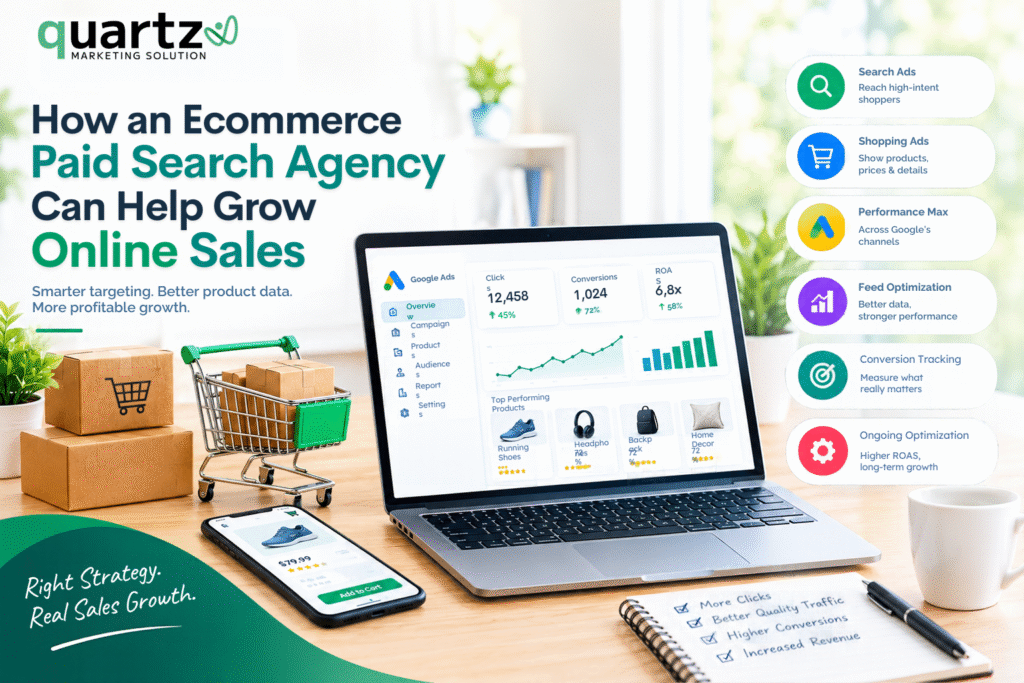
What Services Does an Ecommerce Paid Search Agency Provide?
- Google Search Ads: Reach shoppers searching for specific products or categories.
- Google Shopping Ads: Show product images, prices, and details directly in results.
- Performance Max campaigns: Use your product feed, creative assets, and conversion goals to serve across Google’s advertising channels.
- Keyword research: Find commercially relevant terms and review search-term reports.
- Product feed management: Improve titles, descriptions, attributes, pricing accuracy, and feed health.
- Conversion tracking: Measure purchases and revenue accurately.
- Campaign optimization: Review budgets, bids, products, and structure.
- Landing page optimization: Flag product page, checkout, and mobile issues that hurt conversions.
- Reporting: Connect ad spend to sales and profitability.
Why Ecommerce Businesses Need Paid Search
Paid search puts your products in front of shoppers who are already looking. It also lets you test demand for a new product, support seasonal promotions, and learn which search terms drive buyers.
It has limits, though. Paid advertising doesn’t guarantee sales. Results depend on competition, pricing, margins, inventory, demand, website experience, and tracking quality. A strong agency can improve the controllable parts, but it can’t fix an uncompetitive offer.
How to Choose the Right Ecommerce Paid Search Agency
Before you hire, check for these:
- Real ecommerce experience, not just lead-generation campaigns
- Understanding of product margins and average order value
- Hands-on experience with Google Ads and Shopping campaigns
- Knowledge of product feed requirements
- Clear conversion tracking and reporting
- A focus on profitability beyond clicks
- Experience with your platform (Shopify, WooCommerce, BigCommerce)
- A defined testing and optimization process
- Transparent fees and deliverables
- Regular communication
- Your ownership of, and access to, ad accounts and data
- Realistic expectations about results
A good proposal ties activity to business goals. If it only promises impressions, clicks, or traffic, push back. Ask for relevant examples of past work, and treat them as context, because past results don’t guarantee future performance.
How Google Shopping and Performance Max Fit Into Ecommerce Paid Search
Google describes Shopping ads as being driven by the product data you submit through Merchant Center, rather than keywords. In practice, your titles, images, prices, and availability decide when and how your products appear. A sloppy feed means weak relevance, however skilled the bidding.
Performance Max for retail uses that same feed, plus assets like text, images, and video, to expand reach to additional inventory and formats. It requires a Google Ads account linked to Merchant Center. Search campaigns, by contrast, target specific search queries you choose.
How to Measure Paid Search Performance for an Online Store
Activity metrics show what happened in the ad account. Business metrics show whether it was worth it.
Track ad spend, click-through rate, cost per click, conversion rate, cost per acquisition, tracked revenue, average order value, new customer acquisition, and product-level performance. Where your data is reliable, add contribution margin.
ROAS alone can mislead. A high-revenue product may still lose money after you subtract product costs, shipping, returns, discounts, and ad spend. The right ROAS target is specific to your margins and goals, so be wary of anyone quoting a universal “good” number.
Common Ecommerce Paid Search Mistakes to Avoid
- Sending every ad to the homepage. Match ads to the relevant product or category page.
- Running an inaccurate feed. Audit prices and availability regularly.
- Ignoring search terms. Review them often and add negatives.
- Tracking purchases poorly. Compare ad-platform sales against your store’s own order data.
- Raising budgets without checking profit. Scale what’s profitable, not just what’s busy.
- Promoting out-of-stock products. It wastes spend and frustrates shoppers.
- Neglecting mobile product pages. Test your own checkout on a phone.
- Overlooking shipping and returns. Surprise costs and unclear policies hurt conversion.
- Mixing new and returning customers. When acquisition is the goal, report them separately.
- Changing too much too often. Frequent edits can reset learning and muddy results.
How Paid Search Works With Other Ecommerce Marketing Channels
Channels do different jobs. Paid search captures existing demand, while SEO and content build organic visibility over time. Email and remarketing bring back people who didn’t buy the first time. Social ads can introduce products to new audiences, and conversion rate optimization makes every channel’s traffic more valuable.
Coordinated reporting helps you see each channel’s role without crediting every sale to a single source.
Why Consider Quartz Marketing Solution for Ecommerce Growth?
Paid search rarely works in isolation, and that’s the idea behind Quartz Marketing Solution ecommerce growth partner services. Its service page describes paid advertising across Google Shopping, Performance Max, Meta, TikTok, and Amazon Ads, supported by product feeds and retargeting. Stores that also sell on marketplaces can look at its Amazon Ads optimization support. These sit alongside ecommerce SEO, conversion rate optimization, and email and SMS marketing.
Conclusion
Good paid search management is about more than generating clicks. Online retailers need relevant targeting, accurate product data, reliable conversion measurement, strong product pages, and a clear view of profitability.
If you’re weighing your next step, contact the Quartz team to talk through how Quartz Marketing Solution approaches ecommerce growth for online stores like yours.
FAQs
What does an ecommerce paid search agency do?
It manages paid campaigns that reach shoppers searching for your products. That typically covers keyword research, Google Ads and Shopping management, feed optimization, conversion tracking, testing, and reporting tied to sales.
How does paid search help an online store?
It puts products in front of people with active buying intent, helps you test demand, and supports promotions. It also shows which search terms and products drive purchases. It doesn’t guarantee sales.
What is the difference between an ecommerce PPC agency and a general digital marketing agency?
An ecommerce specialist understands product feeds, margins, average order value, and shopping campaigns. A general digital marketing agency may cover more channels, but sometimes with less depth in retail-specific advertising.
Are Google Shopping ads worth it for ecommerce businesses?
They can be, particularly for stores with accurate feeds, competitive pricing, and solid margins. Worth depends on your costs, competition, and tracking, so evaluate them against profit rather than clicks.
How much does an ecommerce paid search agency cost?
Fees depend on campaign complexity, ad budget, number of products, services needed, and reporting requirements. Ask for a clear scope and fee structure, and be cautious of vague pricing.
How do I choose the right ecommerce paid search agency?
Look for ecommerce experience, transparent reporting, profit-focused thinking, and account access. Ask how they handle feeds, tracking, and testing, and request relevant examples without expecting guaranteed results.