Most businesses aren’t short on software. A typical company running a CRM, an email platform, a scheduling tool, a support inbox, and a few spreadsheets already has more technology than it uses well. What’s usually missing is a way to connect all of it together. Someone is still copying a lead from one system into another. Someone is still checking three tabs to answer a customer question. The tools work fine on their own; the workflow between them is the problem.
That gap is exactly what AI automation consulting services are built to address. Instead of starting with a new piece of software, the work starts with the process itself: where time goes, where information gets stuck, and where AI can realistically take over repetitive steps. Quartz Marketing Solution works with U.S. businesses on exactly this kind of assessment.
What Are AI Automation Consulting Services?
Traditional automation follows fixed rules: if X happens, do Y. It’s dependable but rigid, and it breaks the moment a situation falls outside the rule.
AI-powered automation adds judgment. It can read an email to figure out what a customer actually needs, categorize a lead, or summarize a document instead of just moving it. AI agents go further, carrying out a short sequence of actions on their own, such as pulling information, drafting a response, and flagging it for approval.
AI automation consulting sits above all of this. It’s the work of figuring out which approach, if any, fits a specific process, and how to connect it to the systems already in place. A good consultant starts by watching how work actually happens, not by pitching a tool.
Why U.S. Businesses Are Looking at AI Automation in 2026
The reasons are usually less about chasing technology and more about frustration with specific bottlenecks: leads sit for hours before anyone follows up, data entry eats a meaningful chunk of the week, support teams answer the same questions dozens of times a day, and reports get rebuilt manually every Monday from numbers scattered across four platforms.
None of this requires a company to be “AI-first” to matter. It’s operational drag, and it adds up especially as teams try to grow without proportionally growing headcount.
What Can AI Automation Consulting Help Automate?
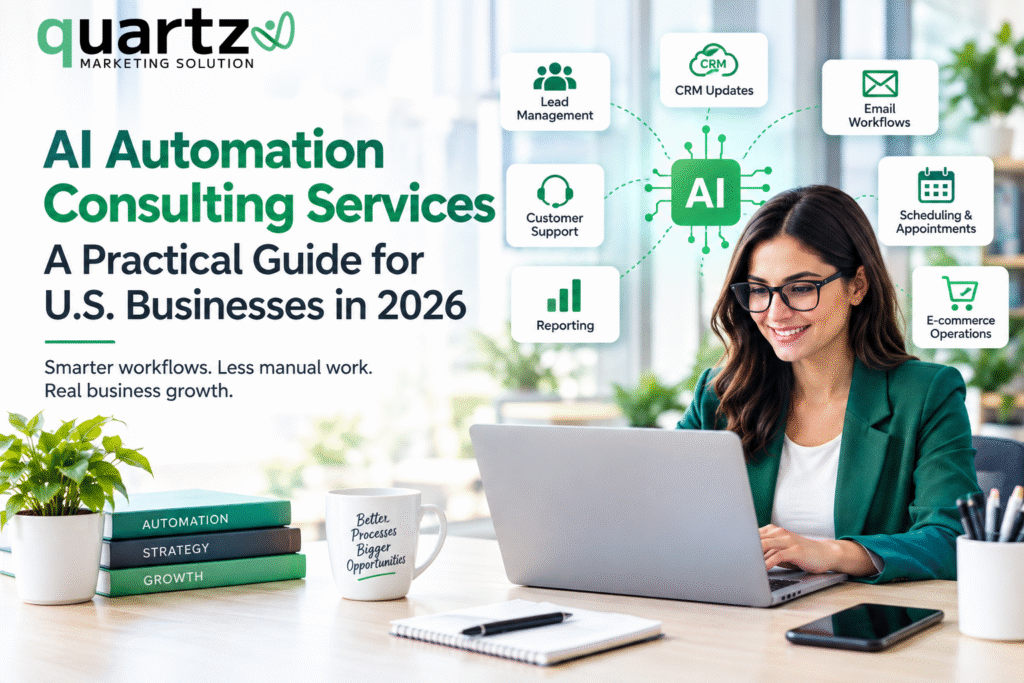
- Lead capture and qualification: leads scored and routed automatically
- CRM updates: records stay current without manual re-entry
- Sales follow-ups: personalized outreach based on behavior, not a generic blast
- Customer support: routine questions handled or triaged before reaching a human
- Email workflows: inquiries sorted and routed to the right person
- Appointment scheduling: booking and reminders without back-and-forth emails
- Reporting: recurring reports compiled from existing data sources
- E-commerce operations: order status and return requests handled with less manual checking
Two examples show what this looks like end-to-end. In lead management: a form submission comes in, the system enriches the contact, scores the lead, updates the CRM, sends a tailored follow-up, and notifies the rep if the lead revisits the pricing page. Nobody touches that lead until it’s worth their time.
In customer support: an inbound message is read, matched against common issue types, and either answered directly using existing documentation or routed to the right team with context already attached instead of sitting in a general queue for a day.
How AI Automation Consulting Works
- Identify repetitive processes: talk to the people doing the work, not just the department head
- Map the current workflow: document every step and handoff
- Find suitable automation opportunities: not everything should be automated
- Select tools and integrations: after the process is understood, not before
- Build and test: run in parallel with the manual process before switching over
- Monitor and improve: automations need adjusting as the business changes
AI Automation vs. Traditional Business Automation
| Rule-Based Automation | AI-Powered Automation | |
| Flexibility | Low — fixed logic only | Higher — adapts to variation |
| Data handling | Structured data only | Structured and unstructured (text, documents) |
| Decision support | None | Can classify, summarize, prioritize |
| Human oversight | Set-and-forget | Still needed, especially early on |
| Typical use case | Simple, repetitive triggers | Judgment-based or variable tasks |
How to Choose an AI Automation Company in the USA
Look for a provider that starts by asking about your goals and current workflows, not by demoing a product. They should work with the systems you already have, explain what they’re building in plain terms, test before launch, and stay involved afterward. Automations that aren’t checked on tend to drift or break quietly.
Data access matters more than people expect. Ask exactly what information an automation will touch and who can see it.
Quartz Marketing Solution‘s AI automation services are built around this process-first approach, understanding a business’s actual workflow before recommending any tool.
Common Mistakes Businesses Make
Automating a broken process just makes the broken process faster. Choosing software before mapping the workflow often leads to expensive rework. Trying to automate everything at once tends to stall the whole project. Ignoring the employees who do the work daily means missing the exceptions that matter most. Poor data quality undermines even a well-built automation. And giving a system more access to sensitive data than the task requires creates unnecessary risk.
Is AI Automation Right for Your Business?
It’s likely worth exploring if your team repeats the same tasks daily, leads sit too long before follow-up, staff move data between systems by hand, or reporting eats real time each week. It may not be the right moment if your core processes are still changing frequently, your data isn’t organized enough to trust yet, or the task volume is too low to justify the setup.
FAQs About AI Automation Consulting Services
What are AI automation consulting services?
Advisory and implementation work that identifies repetitive business processes and determines where AI and automation can realistically improve them.
How much do AI automation consulting services cost?
It depends on workflow complexity, number of systems involved, integrations required, and the level of ongoing support; there’s no universal price point.
What does an AI automation consultant do?
Studies how a process currently works, identifies where automation fits, recommends tools, builds and tests the workflow, and monitors it after launch.
What business processes can AI automate?
Lead management, CRM updates, customer support, scheduling, reporting, and internal data handling are among the most common.
Is AI automation suitable for small businesses?
Yes, particularly for high-volume repetitive tasks like lead follow-up or scheduling, where even a small setup saves meaningful time.
How long does it take to implement AI automation?
A single simple workflow can go live quickly; a multi-system project involving several departments takes considerably longer.
What’s the difference between AI automation and traditional automation?
Traditional automation follows fixed rules; AI automation can interpret variable input and handle unstructured information.
How do I choose an AI automation company in the USA?
Look for one that starts with your workflow and goals, works with your existing systems, tests before launch, and stays involved afterward.
Final Thoughts
Not every process needs to be automated, and no consultant worth hiring will tell you otherwise. The more useful approach is identifying the handful of repetitive, time-consuming workflows where automation produces a real operational difference and leaving the rest alone for now.
If your team is spending too much time moving information between systems, chasing follow-ups, or repeating the same tasks every week, Quartz Marketing Solution can help you look at where AI automation consulting services might realistically fit into your existing operations.