Most businesses don’t have an AI problem. They have a workflow problem that AI happens to be good at solving.
If you’ve ever watched an employee copy the same data between three systems, chase down leads that went cold because no one followed up in time, or spend an entire afternoon answering the same five customer questions, you already understand why AI automation consulting has become one of the fastest-growing services for U.S. small and mid-sized businesses. The tools have matured. What’s changed in 2026 is that companies are finally asking the right question: not “which AI tool should we buy,” but “which of our processes actually deserve to be automated, and how do we do that without breaking anything?”
That’s the gap an AI automation company is supposed to fill. This guide walks through what AI automation consulting actually involves, what a good automation partner does day to day, and how to evaluate one before you sign a contract.
What Is AI Automation Consulting?
AI automation consulting is the process of analyzing a business’s existing workflows, identifying which tasks are good candidates for automation, and designing a system using AI and integration tools that handles those tasks reliably.
It’s not the same thing as installing a chatbot or subscribing to an AI writing tool. Real consulting starts with understanding how work actually gets done inside a business: which steps are repetitive, where information gets stuck, where mistakes happen, and where a human is doing something a system could do faster and more consistently.
From there, a consultant maps out which parts of that process are appropriate for automation, which tools or AI models fit the job, how the new workflow should be designed, how it connects to the software you already use, and how you’ll know if it’s actually working once it’s live. Testing and measurement matter just as much as the build a workflow that technically runs but produces bad data is worse than no automation at all.
Why U.S. Businesses Are Investing in AI Automation
- Saving employee time on manual, repetitive tasks so staff can focus on higher-value work
- Reducing errors that come from manual data entry and copy-paste workflows
- Improving response times for customer inquiries, quotes, and support requests
- Automating lead follow-ups so prospects don’t go cold waiting on a human to circle back
- Speeding up data processing across spreadsheets, forms, and internal reports
- Connecting business systems CRM, email, scheduling, invoicing so information flows automatically
- Supporting sales and marketing teams with faster lead qualification and outreach
- Improving day-to-day operational efficiency without adding headcount
What Does an AI Automation Company Actually Do?
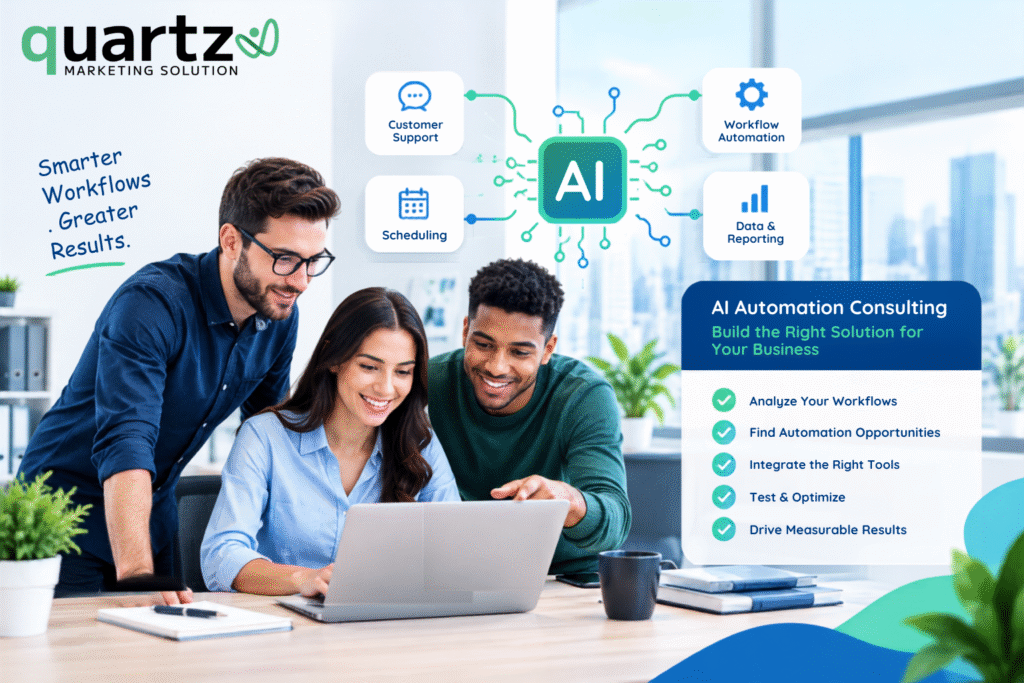
- Business and workflow assessment: understanding how work currently moves through your team
- Identifying automation opportunities: flagging which tasks are repetitive, rules-based, or time-consuming enough to be worth automating
- Selecting the right AI and automation tools: choosing technology based on the problem, not the other way around
- Designing the workflow: mapping out triggers, decision points, and outputs before any building starts
- Integrating existing software: connecting the automation to your CRM, email platform, help desk, or internal databases
- Building and testing: running the automation against real scenarios before it touches live customers or data
- Launching with human oversight: rolling out gradually, with a person checking outputs early on
- Monitoring and improving: reviewing performance and adjusting the workflow as your business changes
AI Automation Use Cases for U.S. Businesses
- AI lead qualification: scoring and routing inbound leads based on fit and intent
- Automated lead follow-ups: sending timely, relevant follow-up messages without manual effort
- Customer support automation: handling common questions instantly while routing complex issues to a person
- Appointment scheduling: letting prospects and customers book time without back-and-forth emails
- CRM updates: automatically logging calls, emails, and form submissions
- Email workflow automation: triggering sequences based on customer behavior
- Document and data processing: extracting and organizing information from forms, invoices, or contracts
- Sales assistance: surfacing relevant account information or next steps for reps
- Internal knowledge assistants: helping staff quickly find company policies, pricing, or procedures
- E-commerce customer support: handling order status, returns, and FAQs automatically
- Reporting and business data workflows: pulling data from multiple sources into a single, current view
- AI-powered recommendation systems: suggesting relevant products or content based on customer behavior
AI Automation Consulting vs. Hiring an AI Automation Company
AI automation consulting typically centers on strategy: analyzing your processes, identifying opportunities, prioritizing what to automate first, and building a roadmap. Consulting-heavy engagements are useful when a business needs clarity before committing budget to a build.
An AI automation company usually goes further, handling not just the strategy, but the implementation, system integrations, development, testing, deployment, and ongoing optimization. This is a better fit for businesses that already know they want to move forward and need a partner who can execute end-to-end.
In practice, many providers, including Quartz Marketing Solution, offer both, so businesses aren’t stuck hiring one firm to plan and another to build.
How to Choose the Right AI Automation Company
- A genuine effort to understand your workflows before recommending tools
- Real experience with integrations across CRMs, ecommerce platforms, and business software
- The ability to customize solutions instead of applying a generic template
- Clear attention to data security and privacy
- A plan for human oversight, especially on anything customer-facing or high-stakes
- A documented implementation process, not just a sales pitch
- Agreement on measurable KPIs before the project starts
- A system built to scale as your business grows
- Ongoing support after launch, not a one-time handoff
- Transparent communication throughout the build
- Compatibility with the systems you already use
How to Start With AI Automation
- Choose one repetitive business process to focus on.
- Document how that process currently works, step by step.
- Identify where the bottlenecks or delays happen.
- Determine specifically where AI or automation could help.
- Estimate the time and cost savings realistically.
- Decide on an automation approach that fits your systems.
- Test the workflow on a small scale first.
- Measure the actual results against your estimate.
- Expand to other processes only once the first one is working reliably.
Why Work With Quartz Marketing Solution?
Once you know where automation can help, the next step is finding the right partner. Quartz Marketing Solution helps U.S. businesses with AI automation, workflow automation, customer support, and lead follow-up automation, tailored to their actual processes.
The approach starts with understanding the workflow, then designing, building, and testing the right automation with human oversight where needed. Explore Quartz’s AI automation services to learn more.
The goal isn’t to use more AI tools; it’s to automate the processes that can make a measurable difference.
FAQs
What is AI automation consulting?
It’s the process of analyzing a business’s workflows to identify which tasks can be automated with AI, then planning how to design, build, and measure that automation, separate from simply buying an AI tool.
What does an AI automation company do?
It handles the full process from assessment through implementation: identifying opportunities, choosing tools, designing workflows, integrating existing software, building and testing the automation, and supporting it after launch.
How can AI automation help a small business?
It reduces time spent on repetitive tasks like data entry, follow-ups, and answering common customer questions, freeing up staff for work that requires judgment and gives a smaller team more capacity without adding headcount.
What business processes can be automated with AI?
Common candidates include lead follow-up, customer support, appointment scheduling, CRM updates, document processing, email workflows, and reporting generally any repetitive, rules-based task with a clear, predictable structure.
Is AI automation expensive for small businesses?
Costs vary widely depending on the complexity of the workflow and the number of systems involved. Starting with one well-defined process is usually more affordable and lower-risk than attempting a large-scale rollout.