Picture a Shopify store with solid products, a clean site, and steady organic traffic. Paid ads bring in sales some weeks and nothing in others.
Now picture a second store. Google Ads sends plenty of clicks, but the cost of winning each customer keeps climbing, and the profit isn’t there.
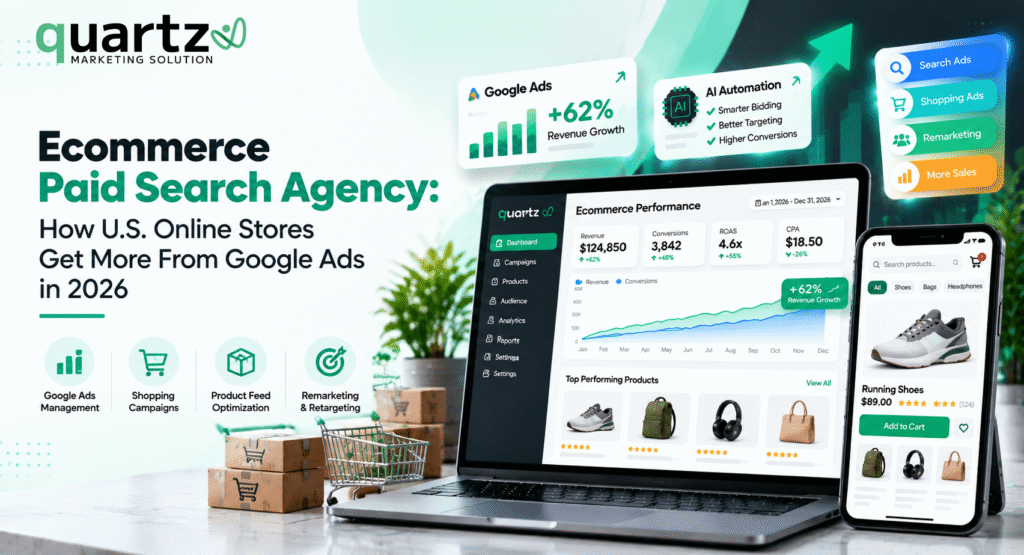
Both stores have the same problem. Running Google Ads is easy. Running it profitably is not. That gap is why many U.S. online stores look for an ecommerce paid search agency: a team that treats ads, product data, tracking, and the website as one system.
What Does an Ecommerce Paid Search Agency Actually Do?
The job is more than building ads. A good agency connects the whole path:
product → search → ad → landing page → purchase → measurable revenue
Day to day, that usually means:
- Managing Google Ads and Shopping campaigns
- Cleaning up and maintaining product feeds
- Researching keywords and adding negative keywords
- Setting up remarketing audiences
- Checking that conversion tracking is accurate
- Allocating budget and adjusting bids
- Testing ads, offers, and landing pages
- Reporting on revenue and profit, not just clicks
Why Paid Search Still Matters for U.S. Ecommerce in 2026
Paid search puts your products in front of people already looking for them. Someone searching “waterproof hiking boots women’s size 8” is much closer to buying than someone scrolling a feed.
A few things make it more important right now:
- Shopping happens on phones. Product images, price, and reviews need to work on a small screen.
- Competition is crowded. More brands bid on the same searches, which pushes costs up.
- Customer data matters more. First-party data, like email lists and purchase history, helps you build better audiences.
- AI is shaping how ads run. Automated tools now handle a lot of bidding and targeting.
What Services Should an Ecommerce Paid Search Agency Provide?
Google Ads Management
This covers campaign structure, targeting, bidding, testing, and ongoing optimization. Good structure lets you see which products and searches actually make money.
Google Shopping Campaigns
Shopping ads pull from your product data: titles, images, prices, and availability. Strong data helps Google match your products to relevant searches. It doesn’t guarantee placement, but weak data limits what the campaign can do.
Product Feed Optimization
Your feed is the foundation of Shopping. A useful audit checks:
- Product titles that include what shoppers actually search
- Accurate descriptions and categories
- Clear, high-quality images
- Prices and stock status that match your site
- Correct product identifiers
A mismatch between your feed and site, like advertising an out-of-stock item, wastes money and can cause disapprovals.
Keyword Research
Not all searches are equal. “Running shoes” is broad. “Men’s trail running shoes wide fit” signals a specific buyer. Good keyword work focuses budget on searches likely to convert.
Negative Keyword Management
Negative keywords block irrelevant searches. A store selling new furniture doesn’t want to pay for clicks from people searching “free furniture” or “furniture repair.”
Conversion Tracking
If tracking is off, every decision built on it is off too. Make sure you’re measuring purchases, revenue, add-to-cart actions, checkout starts, and other meaningful events.
Remarketing and Retargeting
Most visitors don’t buy on the first visit. Remarketing reconnects with people who viewed products or abandoned carts, often with a reminder or a relevant offer.
Performance Reporting
Clicks and impressions are easy to report. Revenue, margin, and new-customer numbers are more useful. Ask for reports you can understand without a translator.
Metrics an Ecommerce Paid Search Agency Should Track
- CTR: the share of people who saw your ad and clicked.
- CPC: what you pay per click.
- Conversion rate: the share of visitors who buy.
- CPA: cost per purchase.
- ROAS: revenue divided by ad spend.
- CAC: total cost to acquire a new customer.
- AOV: average order value.
ROAS is popular, but it doesn’t tell the whole story. A campaign with a strong ROAS can still lose money if product margins are thin. Selling a $40 item with a 20% margin leaves little room after ad spend, shipping, and fees.
So look at profit, contribution margin, customer lifetime value, and CAC together. A store with strong repeat purchases can accept a lower first-order ROAS than a store that sells once and never sees the customer again.
Why Your Website Matters as Much as Your Ads
Ads bring people to the door. The website decides whether they walk in and buy.
Say your ad sends qualified shoppers to a product page that loads slowly, hides shipping costs, and shows two blurry photos. Raising the budget won’t fix that. It will just buy more visitors who leave.
Check these before scaling spend:
- Product page clarity and description quality
- Page speed and mobile experience
- Photos and pricing
- Shipping and returns information
- Reviews and trust signals
- Checkout friction
- Clear calls to action
This is where paid search and conversion optimization overlap. An agency that can spot these problems is worth more than one that only adjusts bids.
How AI Is Changing Ecommerce Paid Search in 2026
AI tools now assist with automated bidding, search-term analysis, feed suggestions, audience insights, ad creative testing, and performance analysis. Used well, they save time and help campaigns adapt faster.
But AI works from the data and goals you give it. It doesn’t know your margins, your brand position, or which products you want to push. People still need to make decisions about:
- Strategy and testing priorities
- Budget and product economics
- Brand voice and positioning
- Customer understanding
AI can improve efficiency. It doesn’t guarantee better results, and it doesn’t replace a marketer who understands your business.
How to Choose an Ecommerce Paid Search Agency
Ask these questions before signing anything:
- Have you worked with ecommerce stores like mine?
- Do you factor in product margins?
- Can you manage Google Shopping?
- How do you handle product feed problems?
- How will you track purchases and revenue?
- Do you focus only on ROAS?
- How do you approach new customer acquisition?
- How often do you optimize campaigns?
- What does your reporting include?
- Do you work with Shopify or WooCommerce?
- Can you spot website conversion problems?
- Are your expectations realistic?
Be cautious of anyone promising guaranteed sales or a fixed ROAS. Nobody controls demand, competition, or Google’s auction.
When Should an Ecommerce Business Consider Hiring an Agency?
It may be time if:
- Ad spend is rising, but profit is unclear
- Shopping campaigns are underperforming
- Feed errors keep piling up
- Conversion tracking can’t be trusted
- Your catalog is growing
- You don’t have time to manage campaigns
- Traffic comes in, but sales don’t follow
An agency may not be necessary yet if your store is very small, demand is limited, or you haven’t validated the product. In that case, fixing the offer and website usually comes first.
How Quartz Marketing Solution Supports Ecommerce Growth
Paid search works best alongside SEO, conversion work, and solid customer data. Quartz Marketing Solution works with businesses across ecommerce marketing, paid search, digital advertising, SEO, lead generation, conversion optimization, social media, and AI automation.
That range helps when the problem isn’t only the ads. If tracking is broken or product pages are weak, it makes sense to address those alongside campaigns. You can learn more on the ecommerce growth partner page.
FAQs
What does an ecommerce paid search agency do?
It manages paid campaigns for online stores, including Google Ads, Shopping, feeds, tracking, remarketing, and reporting.
How much does ecommerce PPC management cost?
There’s no universal price. Agencies typically charge a flat fee, a percentage of ad spend, or a mix. Cost depends on ad spend, catalog size, and scope.
Is Google Ads effective for ecommerce businesses?
It can be, especially for products people actively search for. Results depend on margins, competition, and website experience.
What’s the difference between Search Ads and Shopping Ads?
Search ads are text-based and triggered by keywords. Shopping ads show product images, prices, and store names, and use your product feed.
What is a good ROAS for an ecommerce business?
It depends on margins, AOV, repeat purchases, lifetime value, and goals. A number that works for one store can lose money for another.
How long does it take for ecommerce PPC campaigns to work?
Expect a learning and testing period, often several weeks. Timing varies with budget, data volume, and seasonality.
Should small ecommerce businesses hire a paid search agency?
Only if there’s proven demand and enough margin to fund ads. Otherwise, start with the basics in-house.
How do I choose an ecommerce paid search agency?
Use the checklist above. Look for ecommerce experience, margin awareness, clear reporting, and honest expectations.