Your website looks professional, and your work is solid. Yet Google sends very few inquiries, while a competitor shows up for every search that matters. That gap is rarely about quality. It’s usually about visibility.
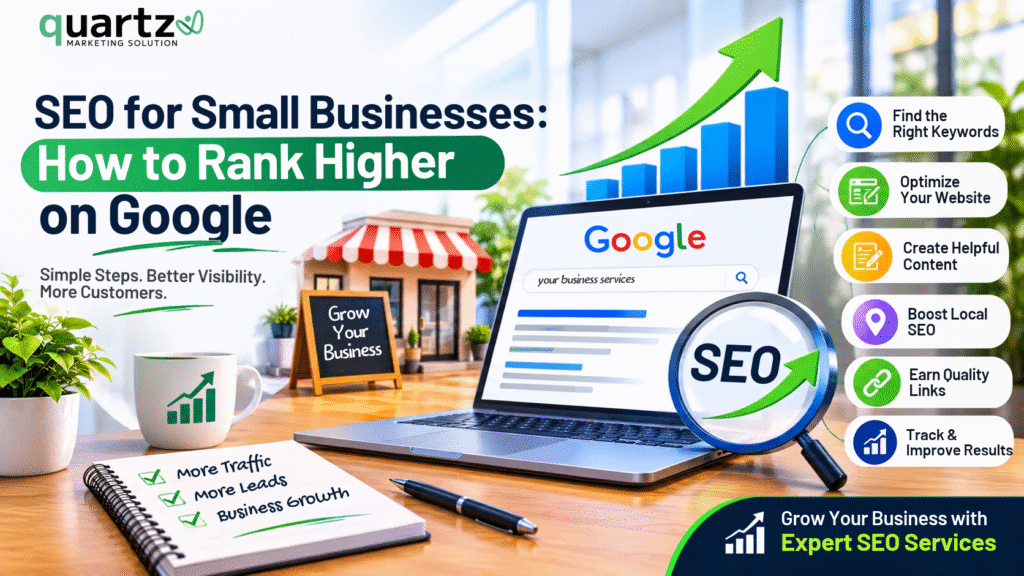
SEO for small businesses comes down to two things: helping search engines understand your website, and helping customers find the right answer when they search. This guide walks through eight practical steps for plumbers, retailers, consultants, and other owners.
What Is SEO for Small Businesses?
Search engine optimization (SEO) is the work of making your site easier for search engines to crawl, understand, and show in unpaid results. Small business SEO usually has two sides:
- Organic SEO reaches people searching for services, products, or answers.
- Local SEO helps eligible businesses appear in Google Maps and location-based searches.
A single-city electrician leans on local SEO. A nationwide online store depends more on product pages and content. SEO also isn’t free in practice. It takes time, expertise, and sometimes paid tools. No honest provider can promise first-page rankings.
How to Improve SEO for a Small Business Website Step by Step
Step 1: Learn What Your Customers Search
Write down your services, the problems customers describe, and the places you serve. Examples include “water heater repair,” “why is my AC freezing up,” and “accountant in Tampa.” Keyword research for small businesses should weigh relevance, competition, and business value, not search volume alone.
Step 2: Give Every Page One Job
Use the homepage for your brand, one service page per core service, and blog posts for questions. A “roof repair” page should convert visitors, while a post on “signs your roof needs replacing” educates them. Avoid several near-identical pages chasing the same phrase. Contractors can see how this works in practice in Quartz’s guide to home services marketing.
Step 3: Optimize Titles, Headings, and Copy
On-page SEO starts with a clear title tag, one H1, logical subheadings, and readable URLs. Your copy should say what you offer, whom you serve, and why you’re credible. Write for people first. Google treats keyword stuffing as a spam violation, and there is no magic keyword count.
Step 4: Create Helpful, Original Content
Answer real questions from your own experience, such as a contractor’s cost breakdown or a consultant’s checklist. Google’s guidance favors a unique point of view over rewritten summaries. Update pages when facts change. If you need help producing it consistently, content marketing services can support the process.
Step 5: Fix Technical Basics
- important pages are crawlable and indexable
- no page has an accidental noindex tag
- robots.txt and your XML sitemap are correct
- internal links aren’t broken
- the site uses HTTPS and works well on mobile
A completed checklist doesn’t guarantee rankings, but it removes barriers.
Step 6: Strengthen Local SEO
For local business SEO, start with Google Business Profile optimization: accurate categories, hours, services, and contact details. Earn genuine reviews and respond professionally. Keep your details consistent across directories. Skip fake locations and copy-paste city pages. Local visibility depends on relevance, distance, and prominence.
Step 7: Earn Relevant Links and Mentions
Industry associations, local partners, community sponsorships, and genuinely useful resources can earn links naturally. Avoid bought links and link schemes. Google’s AI-search guidance also notes that chasing inauthentic mentions isn’t as helpful as it seems.
Step 8: Track Results and Improve
Use Google Search Console to monitor impressions, clicks, queries, and indexing issues. Use analytics to track conversions. Judge success by qualified inquiries, not traffic alone, which is where lead generation services connect SEO to sales. Review performance monthly and improve pages based on evidence.
How AI Search Is Changing Small Business SEO in 2026
Google says its generative AI features are rooted in its core ranking and quality systems, so SEO fundamentals still apply. Publish original, useful content, keep pages indexable, and keep business information accurate. Google also says you don’t need special files or markup, and nothing guarantees inclusion in AI Overviews. Search Console now offers a Generative AI performance report for tracking visibility. For automation that supports follow-up and reporting, see Quartz’s AI and automation services.
How Quartz Marketing Solution Can Support Small Business Digital Marketing
Not every owner has time to manage SEO alongside daily operations. Quartz Marketing Solution is a U.S.-based agency in Jacksonville, Florida. Its digital marketing services cover SEO services, local SEO, technical SEO, content marketing, PPC, and analytics reporting. If paid or social channels fit your plan, the team also offers Google Ads and social media marketing. This support works best when it ties to business goals, such as qualified leads, rather than traffic alone.
Conclusion
Strong SEO follows a clear order: understand customer searches, improve key pages, publish helpful content, fix technical issues, strengthen local visibility, earn legitimate links, and measure real results. Patience matters, because outcomes are never instant or guaranteed. If you want expert help, explore Quartz Marketing Solution’s services or contact the team to discuss your goals.
FAQs
What is SEO for small businesses?
SEO for small businesses is the practice of improving a website so search engines can understand it and customers can find it. It combines keyword research, helpful content, technical fixes, local optimization, and performance tracking.
How can a small business rank higher on Google?
Create helpful pages for what customers search, optimize titles and headings, fix technical issues, complete your Google Business Profile, and earn genuine reviews and links. Rankings depend on competition and relevance, so none are guaranteed.
How long does SEO take to show results?
Google says changes can take hours to several months to appear. Timelines vary by competition, website condition, and effort. Wait a few weeks before judging a change, then keep improving based on data.
Can a small business do SEO without an agency?
Yes. Basics like Google Business Profile, page titles, helpful content, and Search Console are manageable in-house. An agency helps when you lack time, technical skills, or a clear strategy for a competitive market.
How much do SEO services for small businesses cost?
Costs vary with market competition, website condition, scope, and resources. Be cautious of fixed-price promises of rankings. Ask for a clear scope, reporting, and a strategy tied to your goals.
Does SEO still matter with AI-powered search?
Yes. Google states that its generative AI features rely on core Search systems, so crawlable, helpful, original content still matters. No special trick guarantees inclusion in AI-generated answers.