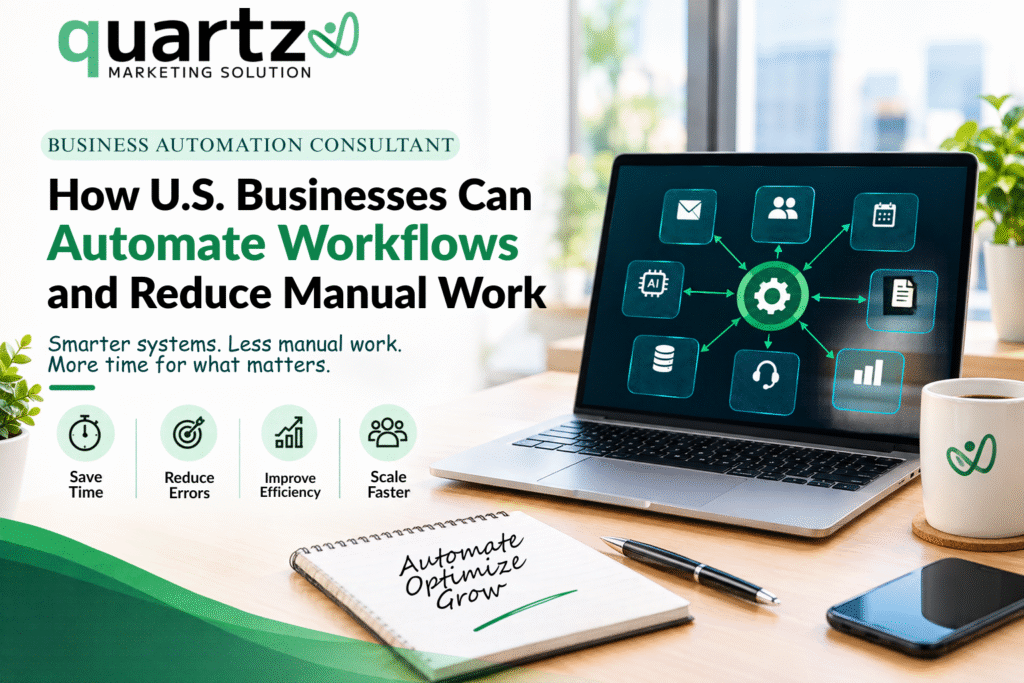
If you’ve ever watched an employee copy the same customer information from an email into a spreadsheet, then into a CRM, then into an invoicing tool, you already understand why so many U.S. companies are hiring a business automation consultant. The work isn’t hard. It’s just repetitive, slow, and prone to mistakes when someone’s tired or rushed.
A business automation consultant looks at how your company actually operates day-to-day, finds the tasks that eat up hours without adding much value, and builds systems that handle them automatically. This article covers what that work looks like, what’s changed heading into 2026, and how to choose the right person for the job.
What Is a Business Automation Consultant?
A business automation consultant studies your existing processes sales, operations, customer service, admin and figures out where manual work can be replaced with automated workflows. The role typically includes:
- Reviewing how work currently gets done, step by step
- Finding tasks that are repetitive, rule-based, or prone to human error
- Mapping the full workflow, including handoffs between people and tools
- Connecting software systems that currently don’t talk to each other
- Building the automated workflows themselves
- Applying AI only where it genuinely fits the problem
- Checking in after launch to fix issues and improve results
Why U.S. Businesses Are Turning to Automation
Most companies don’t set out to build inefficient processes; they just grow faster than their systems do. A ten-person team that tracked leads in a shared spreadsheet still has that habit at fifty employees, except now nobody can find anything.
Common pain points that push businesses toward automation include manual data entry between spreadsheets and CRMs, leads sitting untouched because nobody followed up in time, reporting that takes a full day to compile every month, onboarding paperwork emailed back and forth for weeks, customer support tickets lost between inboxes, and invoices that require someone to manually check and approve. None of this requires heroics to fix it requires a workflow that runs the same way every time, without depending on someone remembering to do it.
What’s Changing Heading Into 2026
- Automation is judged by outcomes, not tools deployed. Businesses care less about which software runs in the background and more about whether follow-ups actually happen faster.
- AI agents are handling more judgment-based steps, not just moving data reading a message, deciding what it’s about, and choosing the next step.
- Orchestration across tools matters more than single-point fixes. Automating one task in isolation helps less than connecting it to the CRM, calendar, and reporting it touches.
- No-code platforms are lowering the barrier, letting operations teams adjust simple workflows themselves instead of waiting on a developer.
None of this means every business needs an “AI-first” overhaul. The businesses seeing real results are automating with a clear goal, not adopting whatever tool is trending.
What Services Does a Business Automation Consultant Provide?
Most business automation consulting engagements touch a few core areas:
- Workflow automation: connecting steps so information flows automatically instead of being re-entered by hand
- CRM and lead management automation: routing new leads, updating records, and triggering follow-ups without manual input
- Email and sales automation: sequencing outreach and reminders based on what a prospect actually does
- Customer support workflows: automatically categorizing and routing incoming requests
- Reporting and data sync: pulling numbers from different tools into one dashboard
- Document and scheduling automation: handling paperwork and appointments that used to require constant back-and-forth
A consultant experienced in business process automation usually starts with one or two of these areas rather than trying to automate everything at once.
Business Automation vs. AI Automation
Traditional business automation is best for predictable, rule-based tasks if a form is submitted, send it to the CRM and notify a manager. It doesn’t need to “think,” just follow the rule consistently.
AI automation becomes useful when a process involves judgment or unstructured information: reading and summarizing documents, classifying support tickets, answering common customer questions, qualifying leads based on how they describe their needs, or pulling specific details out of contracts.
A good consultant won’t push AI into every workflow just because it’s the trend. Plenty of processes work fine, and more reliably, with straightforward rule-based automation. The right recommendation is the simplest one that actually solves the problem.
Signs Your Business May Need an Automation Consultant
- Employees regularly copy information between two or more systems
- New leads are entered into your CRM by hand
- Follow-ups get missed or delayed
- Someone rebuilds the same report from scratch every week
- Customers wait because a request has to be manually routed
- Your team uses several disconnected tools for one workflow
- Managers can’t easily see where a process is getting stuck
How to Choose a Business Automation Consultant in the USA
Look for real experience with workflows similar to yours, familiarity with the software you already use, a clear discovery process before any building starts, attention to data security, documentation you can reference later, a plan for post-launch monitoring, and a defined project scope rather than open-ended promises.
Before hiring anyone, ask: Which processes would you automate first, and why? How do you decide whether something is worth automating? Which tools can you integrate with our current stack? What happens if an automation breaks or produces wrong data? How is our data protected? What support is available after launch?
How Quartz Marketing Solution Can Help
Quartz Marketing Solution works with U.S. businesses that want to reduce manual work without overhauling everything at once. That includes evaluating where AI automation genuinely fits, building workflows around your CRM and lead process, automating marketing and reporting tasks, and connecting the tools your team already relies on.
The approach starts with understanding how your business actually operates, not recommending a stack of tools before anyone’s looked at the underlying process. You can see more about our work at Quartz Marketing Solution.
Practical Steps to Start Automating Your Business
- List out repetitive tasks your team does regularly.
- Write down the current workflow, step by step.
- Estimate how much time and cost each task involves.
- Identify where delays or errors happen most.
- Decide which tasks are actually worth automating.
- Choose tools that fit your existing systems.
- Build and test before rolling out fully.
- Watch how it performs over the first few weeks.
- Adjust and improve as your business changes.
FAQs
What does a business automation consultant do?
They review your current processes, identify repetitive or error-prone tasks, and build automated workflows that connect your software and reduce manual work.
What is business automation consulting?
It’s the service of analyzing, designing, and implementing automated workflows for a business, often including AI where it’s genuinely useful.
How can automation help a small business?
It frees up staff time by removing repetitive tasks like data entry, follow-ups, and reporting, so people can focus on higher-value work.
What processes can a business automate?
Common examples include lead management, CRM updates, email follow-ups, invoicing, scheduling, customer support routing, and reporting.
What’s the difference between business automation and AI automation?
Business automation handles predictable, rule-based tasks. AI automation is better suited to work involving judgment, like reading documents or answering varied customer questions.
When should a company hire an automation consultant?
When manual work is causing delays, errors, or missed follow-ups, or when your team keeps adding tools that don’t connect to each other.
How much does business automation consulting cost?
Pricing depends on the complexity of your workflows, the number of tools involved, and whether ongoing support is included — it varies enough that a proper quote requires understanding your specific setup.
Can a consultant connect different software systems?
Yes integrating separate tools so data flows between them automatically is one of the most common parts of this work.