Sales teams rarely lose deals because reps aren’t trying hard enough. They lose momentum because too much of the day disappears into work that has nothing to do with selling: copying lead details into a CRM, sending the same follow-up email for the third time, updating a deal stage nobody checks, or pulling together a pipeline report the night before a meeting.
That’s a process problem, not a people problem, and it’s why more U.S. companies are turning to sales automation consulting.
The term gets used loosely, so it’s worth being precise. Sales automation consulting isn’t about buying more software and hoping it fixes things. It’s about looking honestly at how a sales team actually works, finding the repetitive or error-prone steps, and building workflows that handle those steps without anyone having to think about them each time.
What Is Sales Automation Consulting?
Sales automation consulting is the practice of reviewing a company’s sales process and designing automated workflows that cut manual work, speed up follow-ups, and keep CRM data accurate.
A few related terms are worth separating:
- Sales automation is the broad category: any tool or workflow that removes manual steps from selling.
- Sales automation consulting is the advisory work of deciding which parts are worth automating and how to build them for a specific business.
- CRM automation is narrower, focused on keeping the CRM itself updated and moving.
- AI sales automation adds intelligence to that automation, letting workflows handle judgment calls instead of just fixed rules.
A consultant’s job is figuring out how these pieces fit together for one company, not applying a packaged solution to every client.
What Does a Sales Automation Consultant Do?
A consultant typically starts by documenting how the sales process actually runs, not how it’s described in a slide deck. That usually involves:
- Reviewing the existing sales process end to end
- Identifying repetitive tasks reps handle manually
- Mapping workflows, including the marketing-to-sales handoff
- Auditing and cleaning up the CRM setup
- Building lead routing and qualification logic
- Setting up automated follow-up sequences and email automation
- Designing pipeline automation and stage-change rules
- Configuring reporting and internal notifications
- Integrating the CRM with other tools the team uses
- Introducing AI-assisted steps where they genuinely save time
Order matters here. A consultant who recommends tools before understanding the process usually ends up automating a broken workflow, which just makes the mess move faster.
Which Sales Tasks Can Be Automated?
Not everything should be automated, but a lot of the repetitive middle-of-funnel work can be:
- Lead capture from forms, chat, or ads
- Lead qualification against basic fit criteria
- Lead scoring
- Lead routing to the right rep
- Email follow-ups after a demo request or form fill
- Appointment scheduling
- CRM record updates
- Sales notifications
- Proposal and contract workflows
- Pipeline reporting
- Customer re-engagement for stalled deals
- Post-meeting follow-up
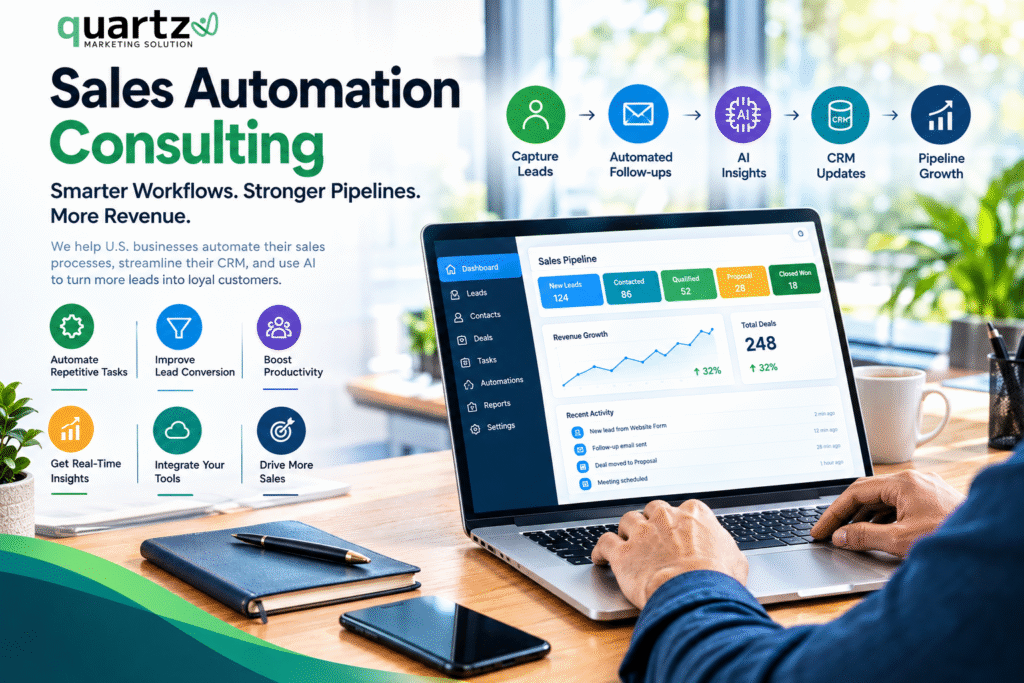
A simple example: a visitor fills out a contact form. The lead enters the CRM automatically, gets routed to the right salesperson based on company size or industry, receives a confirmation email within minutes, and the rep gets notified with the details already attached. No one copies anything by hand, and no lead sits overnight.
How AI Is Changing Sales Automation
Traditional automation runs on fixed rules: if this happens, do that. AI sales automation adds a layer that can interpret information and make judgment calls rather than just follow a script.
In practice, this looks like:
- AI-assisted lead qualification based on form responses or site activity
- Prospect research pulled together before a call
- Draft follow-up emails personalized to a lead’s situation
- Call summaries generated from recorded conversations
- Lead prioritization based on signals a person might miss
- Deal-risk alerts when a pipeline opportunity goes quiet
It’s worth being honest about the limits. AI can speed up research, drafting, and pattern recognition, but it doesn’t replace the judgment a salesperson brings to a nuanced conversation or a high-value deal. Most companies get the best results when AI handles groundwork and a person still reviews anything sent to a customer.
Benefits of Sales Automation Consulting for U.S. Businesses
- Less time on manual data entry and admin
- Faster response times to new leads
- More consistent follow-up regardless of who’s on vacation
- Cleaner, more reliable CRM data
- Better visibility into pipeline health
- Smoother handoffs between marketing and sales
- More time for reps to actually sell
- Easier scaling as headcount grows
None of this guarantees a specific revenue increase. It removes friction from a process that was likely already losing deals to slow or inconsistent follow-up.
Sales Automation vs. CRM Automation
CRM automation is narrower: keeping records accurate, triggering internal tasks, syncing fields. Sales automation is broader and covers the full sales motion, including tools outside the CRM like scheduling software, email platforms, and reporting dashboards. CRM automation is one piece of a larger sales automation strategy, not a substitute for it.
How Sales Automation Consulting Works
- Sales process audit. Map the current process and find where time and leads are getting lost.
- Identify automation opportunities. Prioritize the tasks with the highest time cost or error risk.
- Design the workflow. Build out the logic: who gets which lead, what triggers a follow-up, what counts as qualified.
- Connect CRM and other tools. Integrate email, scheduling, and marketing systems.
- Test, train, and improve. Run real scenarios, train the team, and adjust based on what happens once it’s live.
How to Choose a Sales Automation Consulting Company
- Real experience across common CRM platforms, not just one
- Understanding of B2B and service-business sales processes
- Ability to integrate with tools already in place
- Practical AI and automation experience
- Clear, realistic communication
- Attention to data security
- Custom workflows instead of packaged templates
- Documentation and training, so the team isn’t dependent on the consultant indefinitely
- Ongoing support after launch
There’s no single best provider for every company. Fit depends on your CRM, sales process, team size, and internal capacity.
Is Sales Automation Right for Your Business?
- Reps spend more time on admin than selling
- Leads sit for hours or days before follow-up
- CRM records are outdated or inconsistent
- Leads fall through the cracks between marketing and sales
- Follow-up depends on someone remembering to do it
- Managers can’t get a clear pipeline read without asking around
- The company is growing, and manual processes are breaking down
That said, high-touch negotiations and relationship-driven conversations are usually better left to a person. A good sales automation consulting service will tell you where that line sits rather than automating everything just because it can.
Sales Automation Consulting Services from Quartz Marketing Solution
Quartz Marketing Solution works with U.S. businesses that want more structure and automation in how they sell, without losing the judgment that actually closes deals. Its work spans AI and automation, lead generation, digital marketing, and CRM-related workflow design, so sales automation isn’t treated as an isolated project; it’s connected to how leads are generated and handed off to sales in the first place.
For a business trying to find where its process leaks time or leads, Quartz Marketing Solution starts with the existing process, the way described above, and builds workflows around what the business actually needs.
Conclusion
Sales automation only works when it’s built around a process someone actually understands first. Automating a messy workflow just makes mistakes happen faster. The businesses that get real value from sales automation consulting start with an honest look at how leads move through their pipeline, then build automation around the parts that genuinely need it.
For U.S. businesses exploring AI and automation as part of their sales strategy, Quartz Marketing Solution works through that process step by step, starting with how the sales team operates today.
Frequently Asked Questions
What is a sales automation consulting service?
It’s a service that reviews a company’s sales process and builds automated workflows, such as lead routing, follow-up emails, and CRM updates, to reduce manual work and speed up response times.
What does a sales automation consultant do?
They audit the current sales process, identify repetitive or inefficient tasks, and design workflows connecting the CRM and other tools to handle those tasks automatically.
How does sales automation help a sales team?
It cuts manual data entry and follow-up, so reps spend more time selling and prospects get faster, more consistent responses.
What sales tasks can be automated?
Lead capture, scoring, routing, follow-up emails, scheduling, CRM updates, and pipeline reporting, among others.
Can sales automation work with an existing CRM?
Yes. Most sales automation is built to integrate with a company’s current CRM rather than requiring a switch.
What’s the difference between AI sales automation and traditional automation?
Traditional automation follows fixed rules. AI sales automation can interpret information and assist with judgment-based tasks, like prioritizing leads or drafting follow-ups.
Is sales automation useful for small businesses?
Yes. It lets a small sales team cover more ground without adding headcount.
How much does sales automation consulting cost?
It depends on workflow complexity, number of processes, CRM setup, integrations, and ongoing support needs. No fixed number applies across every business.